Although I’m working from a provisional list of 50-some videos I plan to write about here, I’m going to order them haphazardly, always keeping an eye on anything going on Out There that might make something especially relevant in the moment. I may or may not rank everything when I finish, I don’t know–I highlighted a Top 10 in the aforementioned message-board poll, then organized the rest into groups of 10 that I more less valued equally. As with the previous post, I’ll write about two or more videos at the same time whenever doing so makes sense.
I was going to post about Sinéad O’Connor in the next couple of days, dead at 56, but I’ll put that on hold temporarily for Rihanna–who’s still very much alive, so how exactly has she made news this week? She hasn’t, but the video for “Cheers (Drink to That)” definitively illustrates something of a mini-controversy that has bubbled up in my small corner of the world. Believe me when I say “mini”–thus far, it’s been confined to a few comments on Facebook and a Substack blog. Greil Marcus, from his monthly “Real Life Top 10” column for August 2023:
…it’s always interesting to see how people far from each other in intent and position find themselves speaking the same language, because it can tell you a lot about what values are, as they say, trending. “Imperial,” “in charge”–how great, really, is the distance between Lindsay Zoladz’s celebration from Nate Hochman’s?
Some context. Marcus is writing about a Zoladz New York Times piece on Beyoncé’s current tour, and he’s comparing Zoladz’s words to–subject of the previous entry in his column–a tweet from Nate Hochman, someone who works in the communications department of Ron DeSantis’s presidential campaign. Convoluted enough? The short version: Zoladz, in Marcus’s view, is using the same kind of language to celebrate Beyoncé that others use to celebrate Trump. The shorter version: Nazi. The word turned up in connection to DeSantis’s guy, making the comparison even more incendiary.
In a reader comment posted in response to Marcus, Michael Daddino explained Zoladz’s use of the word “imperial”:
I think Zoladz’ “imperial” almost certainly refers back to the phrase “imperial phase,” used by Neil Tennant to describe a moment in the Pet Shop Boys’ musical life when they were unstoppable. (Unanswerable?) An imperial phase is where a rock musician can do anything, this in a musical genre where anything is possible.
The comment goes on from there for another 350 words, but that’s the core of what the phrase means: that moment–an album, a tour, a window of a few years–when a pop musician is unstoppable. Art, fame, and–crucial, I’d argue–glamour, they all coalesce in a way that’s immediately recognizable when you encounter it. Beyoncé and Taylor Swift right now, Madonna in 1990 (around the time of “Justify My Love” and Sex), Elton John in 1975, and, my own pick for the most awesome imperial moment ever, Bob Dylan in 1966–’65, too, but in ‘66 he’s another girl, another planet. I don’t really ever use the phrase “imperial” myself, because I have a visceral aversion to clichés (except for the ones I use regularly), but the concept describes something real.
Taylor Swift and Rihanna came up in Daddino’s comment, and Marcus, in a short response, drew a distinction between them (and, I’d bet my life savings, between Dylan) and Renaissance-Tour Beyoncé:
It’s an interesting argument, and on Neil Tennant’s terms and yours Beyoncé is surely in imperial territory and has been for a long time. You could say the same for Taylor Swift or Rihanna. But none of them has presented herself as a ruler or a goddess. I think on those terms Lindsay Zoladz had exactly the right word.
Well, I wonder if he’s seen the video for “Cheers (Drink to That),” the seventh and final single from Rihanna’s Loud album (2010), which definitely sits somewhere inside her imperial window, the exact parameters of which I’ll leave for someone else to determine. We’re four years past “Umbrella” at this point, the video (and probably the song, too) that Rihanna’s most famous for. I don’t much care for “Umbrella” as a song, rendering the video more or less moot for me. “Cheers,” though, especially as a video, I find almost hypnotic. And very, very imperial.
It begins with fans–pre-concert, chanting Rihanna’s name, caught up in the frenzy of her imminent arrival–so you could say it’s primarily a video about Rihanna’s love for her audience, not the reverse, and there’s nothing very imperial about that. You could say that, sure–but at the 35-second mark, when Rihanna walks on stage (after some quick cuts of her driving around the countryside and frolicking on the beach; Rihanna at her leisure, away from the pop universe, a recurring motif throughout), she’s about as regal and imposing as it gets: right hand raised high (I’ll avoid going where Marcus goes), white-framed shades (looking as punk-rock as Lou Reed in 1966), denim shorts and flowered halter top (or bikini top–Gianni Versace, I’m not), her sensuous gait cued perfectly to the music as she saunters out from the wings. I don’t know what else to say: she looks spectacular.
The rest of the way you get a dizzying tour through Rihanna’s crowded (most every frame packed with family, friends, fans, and flunkies), itinerant (planes, boats, tour buses, limos), party- and alcohol-mad life, seemingly lived completely in the moment but, I’m guessing, micro-managed and scheduled to the nth degree. From A. Bartlett Giamatti’s A Great and Glorious Game, describing the carnival-like throng inside the lobby of St. Louis’s Marriott Pavilion Hotel during the 1987 World Series:
Add the groupies, the sharpies, the hangers-on, the family members, the deal-makers, the ticket hustlers, the fathers who aim and loose their children like heat-seeking missiles to bring down an autograph, the busloads, of one-time fans, bewildered and giddy…all the cross-cutting, overlapping, salty, blunt, nostalgic sweet conversation about only one subject–Baseball.
Change “Baseball” to “Rihanna,” and that’s more or less this video. Avril Lavigne turns up a couple of times, part of the never-ending revelry. (“Cheers” samples Lavigne’s “I’m with You.” Rihanna was probably a 14-year-old fan of Lavigne when “Complicated” came out in 2002; now, the presumption is, they’re good friends and drinking buddies.) Kanye West is glimpsed briefly. Rihanna has also seen your video, but unlike the Replacements, she loved it and filed it away in memory: at the 48-second mark she flips a heavy-metal gesture with her hands, and at 2:32, and again at 2:49, she’s John Lydon. She embraces people throughout, including someone at 0:55 where–getting back to the imperial idea–her smile feels like it carries with it an unspoken “It’s okay, I want to do this.”
For all of the hedonistic overload on display in its video, “Cheers (Drink to That)” is rooted in a serious, traumatic event: the physical assault Rihanna suffered at the hands of her then-boyfriend Chris Brown in early 2009. Actually, it’s not accurate to place the hedonism and the trauma in direct opposition: “Cheers” is intended as an anthem of defiance, a hearty fuck-you to the people who want to do you in–“the haters,” as the kids used to (and maybe still do) say. “Don’t let the bastards get you down”–defiant to the point of being a revenge fantasy, not of a physical sort, but instead the revenge of a life well lived.
Life’s too short to be sittin’ ’round miserable
People gon’ talk whether you doing bad or good, yeah
Got a drink on my mind and my mind on my money, yeah
Looking so bomb, gonna find me a honey
Chris Brown is clearly the #1 object of Rihanna’s ire; more generally (“People gon’ talk”), it’s social media and the Twitter/TMZ universe we live in. Which, just as clearly, is inextricably bound up with Rihanna’s fame and imperial stature, a feedback loop that, although nothing new–it’s the very essence of celebrity–has been rendered exponentially more perilous by social media. I wanted to bring it all back home to Dylan and compare “Cheers” to “Positively Fourth Street”–one imperial revenge fantasy to another–but they’re not all that similar: there’s no concurrent self-empowerment message found in Dylan’s screed, it’s just laser-like bile from start to finish, Tom Cruise in Magnolia (“I’m quietly judging you”) but not quiet at all. And by 1966, to return to the idea that “an imperial phase is where a rock musician can do anything,” Dylan’s even untouchable and confident enough to mock his slightly earlier self: “You’ve got a lot of nerve to say you are my friend/If you won’t crawl out your window.” Rihanna is Dylan’s equal in the glamour and fame department on “Cheers,” but I don’t know that she documents the hall of mirrors she finds herself navigating with as much lacerating wit as Dylan. Few do.
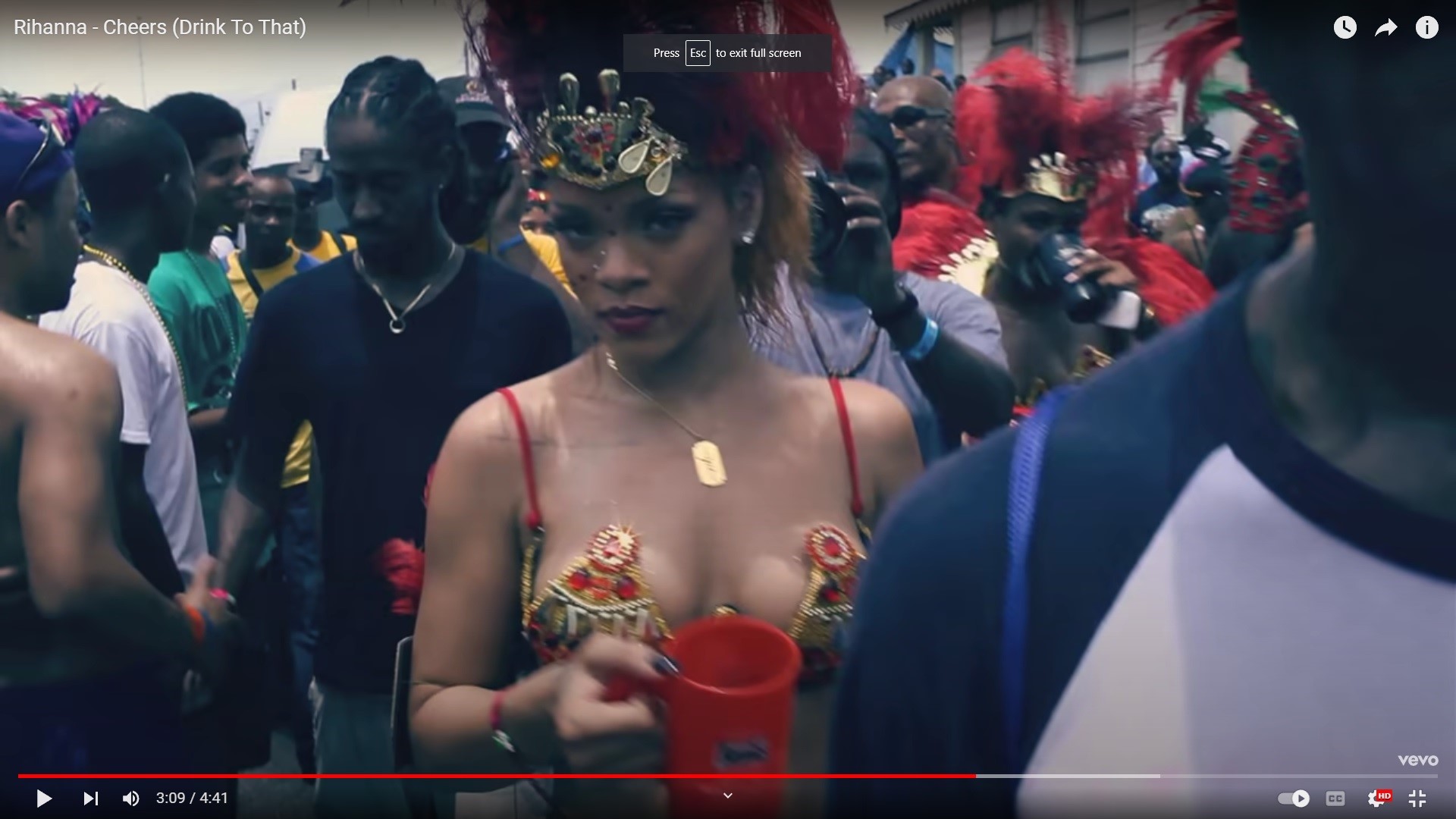
There are so many images I stop and linger over whenever I revisit “Cheers” (Drink to That)” on YouTube; I’ll finish with one at 3:09, the third of three successive, almost subliminal freeze-frames that are meant to evoke (and may in fact be) selfies being snapped. I don’t know exactly where Rihanna is, but she seems to be taking part in a carnival-type street festival, presumably in her home country of Barbados. She’s in full costume, celebrating alongside fans, part of the procession. First selfie: broad smile, inside a bus, cell phone to her ear, posing with someone who’s part of her entourage. Second one: same bus, same someone, hoisting a drink–seems to be only seconds later. Third: out on the street now, drink in hand, surrounded on all sides by people (every person male, as far as I can tell), all of them oblivious to her, Rihanna staring directly at us. With her eyes narrowed, and head tilted ever so slightly to the right, her stare travels past us–burns a hole right through us–and lands somewhere beyond. You can decide for yourself where; I’ll go for the most obvious answer, that it lands on Chris Brown. She sees that he’s still out there: still making records–I had both “Cheers” and Brown’s “Beautiful People” on my Pazz & Jop ballot that year–still gathering Instagram followers, still telling his side of the story. And she’d rather see him paralyzed.
 we don't want to know