Social media’s thriving obituary industry–I’m not blameless–was in overdrive a few weeks ago with Sinéad O’Connor’s death. Among pop musicians, I think I saw more Facebook posts, message-board threads, and general commentary than for anyone since Tom Petty in 2017 or, just prior to that, Prince in 2016. When Michael Jackson died on June 25, 2009, an R.I.P. thread was opened for him on the ILM message board at 5:48 p.m. that afternoon; by the end of the day, I’d estimate another two or three hundred posts followed, with hundreds more in the next day or two. That was in 2009–I bet you’d quadruple that today. What would it have been like for John Lennon’s death?
I post about someone’s death on Facebook probably a dozen times a year. Most concern people who had a small window of fame many years ago–a Watergate burglar, a director who made one memorable film and never came anywhere close to that again, a Mark Fidrych-like rookie sensation (or Fidrych himself even) who flamed out early–and who somehow take me back to my younger self and the world we both lived in. These are my favourite kinds of deaths. (I know how grossly inhumane that sounds–grim social-media humour.) That goalpost, between ubiquitous and marginal fame, keeps moving. There was a time I would have posted about Bob Rafelson, who died two weeks ago, calling attention to how iconically ‘70s and how important to me personally Five Easy Pieces is. There was so much posting on the message board, though, anything I had to say was redundant; it was like Orson Welles had just died. (More grim humour: I’m sulking because my obsession isn’t just mine anymore.)
I did post about Sinéad O’Connor, right when I heard about her death, but it was more about how I was wary of stepping into any kind of discussion. My reasoning was that O’Connor’s very public traumas and ordeals were a modern-day landmine–that to even say you didn’t always understand why she did the things she did was to invite scorn and sarcasm; she was physically abused as a child, she had a son who committed suicide, end of story. I was someone who was 100% supportive of her during her Saturday Night Live controversy decades ago (and no less over the way she was treated a few months later at that Dylan concert) but, within the past decade, I’d see occasional news items–usually concerning something she’d posted online–and I’d be puzzled. But I’ve learned that on social media, it’s best to stay away from any discussion involving the death of someone famous who inspires very protective feelings. Unless, of course, you share them unreservedly.
None of which has anything to do with how remarkable I’ve always thought “The Emperor’s New Clothes” is. 1990 might have been the only year in the past thirty-five-plus where I didn’t compile a year-end Top 10–I was at teachers’ college in Windsor and a little detached; Cecil Fielder chasing 50 HR across the river in Detroit was of more immediate concern–but I know I would have had “Emperor” on there if I had. I did have it at #38 on a Facebook countdown I did in 2010 (with Steven Rubio and Jeff Pike) of my favourite songs ever. I was, like much of the pop audience, already quite taken with “Nothing Compares 2 U”; I strongly associate its dash to #1 with a family trip to Florida that winter, my dad and I driving down to meet my mom and sister, the song everywhere on the radio. (Wow–on the very eve of the internet, a moment where “everywhere on the radio” meant something it would never quite mean again.) And taken with the video too, of course, which I would, when I eventually got my own classroom, play for hundreds of grade-school kids over the years as part of a history-of-music-video thing I did for media studies. “See that? Can you see the teardrop?” That was probably my first thought upon hearing news of O’Connor’s death, the same thought I always have when someone I used to talk about in the classroom dies: that I wanted to believe all those kids were looking at a computer screen somewhere, thinking “Oh yeah, I remember her…”
I mentioned “The Emperor’s New Clothes”’ video in the accompanying comment I wrote for the Facebook countdown, drawing a parallel between O’Connor’s defiantly idiosyncratic dance moves–she’s got a rhythm that nobody can write out–and those of Joy Division’s Ian Curtis (most memorably seen on the official video for “Transmission,” which I’d be writing about here if it weren’t a live clip) and Feargal Sharkey of the Undertones (whose “It’s Going to Happen!” I’ll get to eventually). The video takes place in some nondescript performance space–the stage looks more like a puppet theatre–not unlike the one where the Bee Girl’s tap-dance routine would get laughed at in Blind Melon’s “No Rain” video just two years later. The audience, glimpsed in quick cutaways throughout, feels like an abstraction, a hastily assembled focus group, with no connection whatsoever to what’s going on in front of them. Sinéad gives it her all, though, with a variety of indelible moves you can try out yourself next time you’re out dancing:
1) the Right-Hand Flip-Flop (30 seconds)
2) the “Uh, I Don’t Think So” hand wave (40 seconds)
3) the Kubrick Stare (on loan and, thanks to a certain mugshot making the rounds, very much in the news as I write) (1:16)
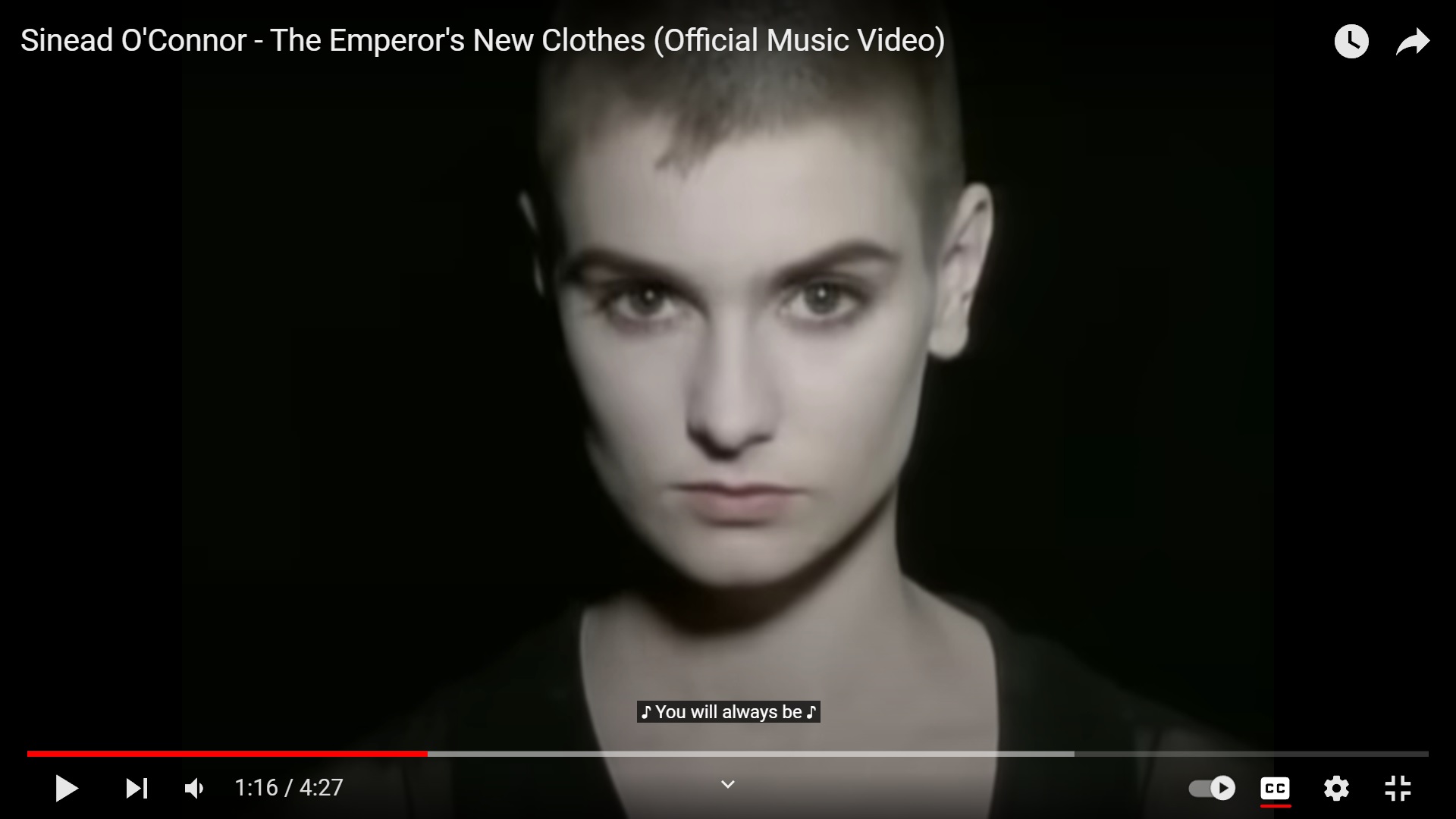
4) the “I Saw Tom Cruise Do This in The Color of Money” hair swipe (1:26)
5) the “I’m Dancing So Fast Now I Can Be in Two Places at Once” (2:24)
6) the “I Just Snuck In a Secret Satanic Hand Signal” (3:00)
Disco balls float overhead, a tribute to Sinéad’s Travolta-like prowess, and the cutaways include a shifty-eyed blond guy, a grandmother busily knitting, and a Paul Sorvino stand-in who looks quite bored. One recurring image, showing up three or four times, is a quick close-up of Sinéad in the bottom right-hand corner of the frame, like she’s hiding just below the stage and looking up at herself; it evokes the image that was used for the cover of I Do Not Want What I Haven’t Got, the #1 album that housed both “The Emperor’s New Clothes” and “Nothing Compares 2 U.” She’s lost in a dreamy thousand-yard-stare on the album cover; in the video, her expression is more pensive in these shots.
As with the Bangles’ “Goin’ Down to Liverpool” video, all the dancing and disco balls and confetti are almost comical counterpoint to the seriousness of the song, which is an angry rebuke to anyone who chooses to pass judgment on O’Connor–over her single-mother pregnancy, her beliefs, the way she looks, her career, her very existence.
I will sleep with a clear conscience
I will sleep in peace
Love that. Another line, “How could I possibly know what I want/When I was only twenty-one?” (possibly referring to things she wrote on her debut album two years earlier), was on my mind when I started to formulate a genre of songs whereby young artists–maybe in their early 20s, maybe even teenagers–start reflecting upon their lives like they’re Malcolm Cowley writing The View from 80. Some others: Neil Young’s “Sugar Mountain” (“You can’t be 20 on Sugar Mountain”–composed the day Young turned 19), the Lovin’ Spoonful’s “Darling Be Home Soon” (“A quarter of my life is almost past”–that “almost” was pretty optimistic, seeing how John Sebastian was 21 at the time),* Jackson Browne’s “These Days” (“I seem to think a lot about the things that I forgot to do”–he was 16, so he must have been referring to household chores), Carole King’s “Goin’ Back” (“I think I’m returning to all those days when I was young enough to know the truth”), Fairport Convention’s “Who Knows Where the Time Goes?” (Sandy Denny was 20), Joni Mitchell’s “The Circle Game” (“We’re captive on the carousel of time”–23) and “Both Sides Now” (25), the Beatles’ “In My Life” and “Help!” and “Yesterday” (mid-20s). The subject has especially been a preoccupation of (obvious irony) Young’s. “Tell Me Why” (“When you’re old enough to repay/But young enough to sell”–Neil was 25), “Old Man” (“Look at how the time goes past/But I’m all alone at last” (27–24 when he actually wrote it, if the lyrics are to be taken literally), “Time Fades Away” (28), “Cortez the Killer” (“I still can’t remember when or how I lost my way”…well, he’s 30 by then, which in the context of this genre actually does count as a senior citizen). Dylan, meanwhile, as he often does, chimes in from some alternate universe: “But I was so much older then/I’m younger than that now.”
Whatever peace O’Connor found, or thought she had found–or claimed she had found, even though she knew she really hadn’t–obviously didn’t last very long. I could, I suppose, use her death as good reason to investigate all the music she made after I Do Not Want What I Haven’t Got, almost none of which I’ve heard (there was a stately Loretta Lynn cover, “Success Has Made a Failure of Our Home,” on her third LP that I liked at the time). But I know I won’t. I just don’t have the curiosity anymore that might have once sent me down that road. I’m happy with “Nothing Compares 2 U” and “The Emperor’s New Clother,” and even happier with this video.
*Still alive at 79–almost there.
 we don't want to know