I was going to start this post with the death of Bob Barker a couple of weeks ago–explanation forthcoming–but I found a much better stepping-off point sitting in my inbox the other day, Greil Marcus’s “Real Life Top 10” column for August 2023. His 10th and final entry was about a new Pet Shop Boys compilation, Smash (considerably more comprehensive than the one I have, 1991’s Discography):
Three discs, 54 songs, plus two DVDs of videos which I didn’t watch then and didn’t watch now, because with melodies like these, images can only get in the way of surrender–and daunting.
Knowing some of the things Marcus has written about “Like a Rolling Stone” over the years (including a full-length book), and knowing I was just about to tackle the song’s “official” video, my first thought upon reading those words was “Wow–I wonder what he thinks about this?”
There are a few generational dividing lines I can think of where people of approximately my age weren’t able–and often weren’t even interested in trying–to make it from one side to the other. Punk was far and away the easiest to navigate: I can’t think of any of my friends who didn’t love punk, or at least the first iteration of it in the 1970s out of New York and England. Disco, just slightly less so: most of my friends like lots of disco, a few don’t. Hip-hop was a big one. If I were to divide my friends at the time into those who wrote about music and those who didn’t, the first group (including me) took to it enthusiastically, while the second, usually friends dating back to high school who shared my obsessions for talking about music and buying albums, started to lose the plot.* Somewhere between disco and hip-hop–or concurrent with hip-hop, depending upon where your timeline begins–there was music video. I think with most of my friends, it was a case of not being interested rather than open hostility. Videos simply weren’t, at least until Nirvana came along, a commercial priority with the bands we loved, and for us, buying their albums and seeing them play clubs was everything.
I’m generalizing, of course. It was the same friend, Peter–not a music writer–who got me onto punk and hip-hop. And none of this has anything to do with Greil Marcus, who 1) is 15 years older than me, and 2) has also written lengthy appreciations of certain videos (two that come to mind: “Smells Like Teen Spirit” and R.E.M.’s “Man on the Moon”).
The point I’m fumbling towards: if you’re of a certain age, at least half the music you ever loved predates video, and you will always hear that music completely free of any competing visual imagery, other than what you supply yourself. Marcus didn’t want that kind of interference with his favourite Pet Shop Boys songs, so he made it a point to dodge videos that were included in Smash. That was never an issue for the first two-plus decades of pop music history. There are no videos to go along with “Cinnamon Girl” or “Family Affair” or “Tears of a Clown” or “Pictures of Lily” or “Walk on By” or anything else you can name from before the mid-late ‘70s. (Wait a minute–there is what amounts to an actual video for “Walk on By”; it’s conceptual and scripted and everything. We’ll get to that one later, along with a few other exceptions.) And, until 2013, there was no video for “Like a Rolling Stone,” either, when Bob Dylan and/or CBS commissioned Vania Heymann to come up with something to promote the release of The Bob Dylan Complete Album Collection Vol. 1.** Pitchfork’s Jenn Pelly took a look at Heymann’s creation and anticipated fan reaction succinctly: “Your go-to ‘Is nothing sacred?!’ outburst will not even cut it here.”
Where to begin? A good place might be to talk about what the video isn’t. There’s nothing relating to JFK, or Vietnam, or the Civil Rights Movement; no Castro, no Cold War imagery, no bomb shelters; Woody Guthrie, Pete Seeger, and Joan Baez are nowhere to be seen. Heymann takes you right out of the familiar terrain from which Dylan’s greatest work emerged and (literally) plunks you down into the most un-Dylan-like universe imaginable: a cable-TV feed encompassing 16 different channels showing 16 different shows. That’s the first gimmick. Gimmick #2: the video is interactive, so, by clicking on one of the up or down arrows to the left, you can change the channel. Gimmick #3, the true masterstroke: everyone in the video, whether Drew Carey or hip-hop artist Danny Brown or the bald guy on Pawn Stars, is lip-synching “Like a Rolling Stone.” The only person in the video not lip-synching is found on channel 121. He’s actually singing, or at least he was in 1966.
I feel like it’s important to give a full accounting of all 16 channels before proceeding. I know that’s what baseball writer Joe Posnanski would do, so let me run them down in order of appearance. If nothing else, I need an epic-length post to match the epicness of “Like a Rolling Stone.”
Channel 122: Music 1 Bass – The hip-hop channel, with Danny Brown. I almost put Brown on my 2012 Pazz & Jop ballot for “Grown Up,” the only song I know by him. He sings, eats, and gesticulates emphatically with his hands here, while every now and again a lyric appears on the screen in a vintage early-’80s graffiti-style font.
Channel 123: Shop TV – A man (mustachioed and casual) and a woman (blonde and bejewelled) are hawking a dustbuster for $29.99: “strong, resilient, all-surface.” 6168 have been sold–the number ticks up as you watch–and if you also order a Magic Brush within the next hour, you get a second one free.
Channel 124: History Network – Some very scholarly-looking people, tenured professors presumably, sit in their offices and pontificate on the Great Depression. I get the feeling that they’re all well known academics I should know, but I don’t recognize any of them. Their insights are intercut with old black-and-white footage of the event itself–in which, yes, people are glimpsed singing along to a song that won’t be written for another 30 years.
Channel 125: Moviez – It’s Rom-Com Weekend, and the film, Love Is Love, is definitely fake. A fresh-faced couple stands outside a brownstone and earnestly discusses something about scrounging their next meal. They laugh and embrace, the issue seemingly resolved.
Channel 126: TTC – An episode of Bachelor’s Roses, a Real Housewives-type reality show, where women sit around and hiss, snipe, and wave fingers at each other. When the nastiness reaches critical mass, someone storms out of the room Bette Davis-style. I’m in awe of how sublimely perfect a dramatization of “Like a Rolling Stone” this is, and how seamlessly Dylan’s diva-like tendencies in 1965 would blend in here.
Channel 127: MTC Business – It’s the Wall Street Market Update, with the standard visual overload of a stock-ticker across the bottom (two stock-tickers, actually), scrolling news flashes (“JUST IN: REPORTS CONFIRM POLICE STILL OCCASIONALLY KILLING HOODED TEENS SPORADICALLY”–the video is so meticulous, I take it for granted that the redundancy of the second adverb is intentional), a graph, and a couple of reporters–one in a studio, one via remote–to make sense of it all.
Channel 128: Cuisine – An aproned, somewhat matronly-looking woman in a studio kitchen prepares a “Decadent Dessert” consisting of two cups each of raspberries, blackberries, and strawberries, one cup of brown sugar, three tablespoons of cornstarch, three cups of flour, three tablespoons of baking powder, one tablespoon of salt, half a cup of butter, and one-and-a-half cups of half & half (cream, I think), lemon peel shavings, and one whole lemon.*** As we stare into the vacuum of her eyes, she returns our gaze throughout–often with the trace of a smile over some private amusement.
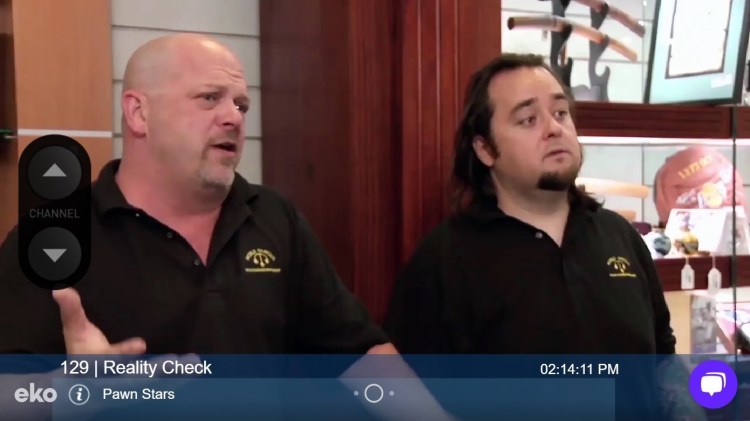
Channel 129: Reality Check – Pawn Stars, a real program that has exerted an odd fascination for me the past few years because of its central conceit: that the guys who run this Las Vegas pawn shop are more learned and erudite than the three professor types over on Channel 124. Whatever items are brought in for appraisal, one of the three–the father, who runs the store, or one of his two sons–will launch into the most detailed, arcane explanation of the item’s significance and the historical context from which it has survived. Doesn’t matter: Civil War weaponry, Imperial Russian furniture, baseball in the 1920s, contract bridge, the earliest days of photography–they’re experts on anything and everything, and, unless it’s tacked on somewhere in the end credits, there’s no mention that the show might be scripted. Anyway, this is one channel that had to be there: “You better take your diamond ring/You better PAWN IT, BABE” the father advises a customer, not adding any special emphasis to his lip-synching on the line. He seems to miss the joke.
Channel 130: Look TV – The fashion station. One reporter stands in front of a monitor that’s carrying a runway show, another interviews people on the street, and nestled between there’s a 30-second promo for a show called Girl Code, which promises “Apologizing…Leggings…Vaginas.” I always wonder what Dylan must have thought about all of this–I’m assuming there was no hands-on involvement from him–nowhere more so than with “Apologizing…Leggings…Vaginas.” In any event, I’d estimate that I’ve looked at the “Like a Rolling Stone” video at least 50 times in the decade that it’s been around, stopping here and flipping around there, something different every time, an ever-expanding array of permutations and combinations. It’s only today that I discovered the Girl Code promo; it was such a surprise, my first reaction was that someone must have hacked into Dylan’s website and doctored the video.
Channel 131: Game Show Channel – This was the Bob Barker connection I mentioned earlier: The Price Is Right is showing. It’s the current iteration, though, the one with Drew Carey, who’s now approaching a tenure about half as long as Barker’s (Carey’s in his 16th year as host: Barker was there for 35). The contestants are spinning the giant wheel, trying to get as close to a dollar as they can without going over, a popular segment on the show that launched a million internet jokes–one joke, really–when Barker died at the age of 99. Someone named Bill wins the Wheel Game in the video by spinning exactly a dollar–this is looped in a way that doesn’t really make sense–then he wins a car, again in a way that doesn’t really make sense. “How does it feel?!” Carey calls over to him with palpable delight. My sense is that Carey had more fun than anybody making this.
Channel 132: WTFC – Except for maybe Marc Maron, that is, who must be a Dylan lover from way back going by the Gimme Shelter poster prominently displayed over his shoulder as he interviews somebody for his popular podcast. Maron is one of those prototypical internet success stories I just don’t know anything about, or at least anything beyond his status as an internet success story. I’d say I’ve never heard him, but he had a small cameo in Joker that I would have seen.
Channel 133: SportsTime – It’s the Pan-Asia Tennis Tournament…not real; there’s something called the Toray Pan Pacific Open, but that’s just for women. I’ve resumed playing tennis the past two summers, after abandoning the game for a few decades. I love it–golf, previously my preferred summer sport, is far too complicated. As the two players in the video (Diovesky and Plotnovich, seemingly a sideways bifurcation of Novak Djokovic) exchange lyrics during their game, this becomes the perfect song for trash-talking, “Like a Rolling Stone” channeled through John McEnroe: “Now you don’t talk so loud/Now you don’t seem so proud.”
Channel 134: Home+ – Even more than Marc Maron, the Property Brothers are a modern-day phenomenon who make zero sense in the context of 1965. But just like those ferociously bickering women over on Channel 126, they’re made to order: “How does it feel?/To be without a home…” No one in the Property Brothers’ world is ever without a home; the only cause for concern is finding a better one, with more amenities and a higher resale value down the road.
Channel 135: Just for KIDS – Zoey and Socks: animated, created specifically for the video, maybe the most surreal detour of all. A cat is suspended mid-air, flowers sway gently and cheerfully in rhythm with the song, words pop up at the bottom of the screen with one letter missing. It’s an educational cartoon. The gravity-defying cat falls asleep at one point, the background changes–now both the cat and the young girl he’s speaking to are up in the clouds–and he looks to be angry for some reason. Quite hypnotic; reminds me of watching Rocket Robin Hood in the mid-‘80s one of the two or three times I dropped acid in my life.
Channel 136: BCC News – Another news anchor sitting at a desk, not noticeably different from Channel 127. Stories being covered include “Occupy Is Back” rioting (the return of the Occupy Wall Street protestors; I can’t find any evidence that this actually happened in 2013) and the “War on Crime” (that one never ends); there’s a weather segment, where captions scrolling across the bottom tell of typhoons, fires, and flash floods. Definitely in keeping with the apocalyptic-prophet side of Dylan, but, because it comes so late in the feed, probably the least surprising channel here.
Channel 121: Music 1 Classics – Which may just be a strategic set-up, because as you flip ahead from Channel 136, suddenly, for the first time, there he is: Dylan gets the first channel numerically but the last one to show up in the video, bringing it all back home, so to speak. It’s 1966, and you’re right there with Dylan, the Band, the audience–famously divided between those shouting “Judas!” and those ready to go anywhere–and “Like a Rolling Stone.”**** Dylan is the most arrogant, the most beautiful, the most everything person on the planet, and the strange world we’ve just been sampling piecemeal vanishes. It doesn’t even yet exist.
The net effect–of Dylan popping up at the last second, of everything that has preceded him–is overwhelming. The disconnect between what you might have envisioned for a video to accompany “Like a Rolling Stone”–different for everybody, an interactive cable-TV feed for nobody–and what you’ve seen is so vast, and so disorienting, you may not even be sure you’ve seen what you’ve seen. So you go back for another look, and then a third, and it’s different every time, and it never ever changes. The song is bigger than the video, bigger than the form, bigger than the world; it subsumes everything in its path. What if the only language available to people were “Like a Rolling Stone”–what would that look like? What would it feel like? It would look and feel like this video. And it would be enough. Everything that needed to be said would still be said.
I realize that many will react very differently. I’m always amused when someone creates an audacious piece of art–a film, an album, a building; yes, I think the best music videos are art–and people who love it seem aggrieved that there are others who hate it with an intensity at least as fierce as their advocacy. That was part of the artist’s intention, obviously, and also part of what you love about it, the provocation. (With, I believe, a measure of self-satisfaction that you get this thing that others don’t; you’re in some kind of secret pact with the artist.) I don’t really know how credit for this video should be apportioned–all of it to director Heymann, or was the idea and execution the work of numerous collaborators?–but “Let’s come up with some radically strange way to make a video for ‘Like a Rolling Stone’” wasn’t nearly enough in and of itself. There are dozens and dozens of equally weird videos for “Like a Rolling Stone” that were never made, and I guarantee I would have hated them all.
*Maybe a fourth dividing line, too: the reigning pop sensation of the day. The Beatles, Elton John, Madonna, I loved them all, of course, then and now. New Kids on the Block, there was at least a ballad of theirs that I had on a year-end Top 10. But with Taylor Swift, I’m left thinking “I’m missing something here–maybe I don’t like pop music anymore.” I’m on the wrong side of the divide when it comes to Taylor Swift.
**It should be mentioned here that the opening of D.A. Pennebaker’s Don’t Look Back (1965)–Dylan ducking down an alleyway, racing through a haiku version of “Subterranean Homesick Blues”’s lyrics on cue cards while the song blares on the soundtrack, with Alan Ginsberg and Bobby Neurwith lurking in the shadows–functions as a de facto video that has come to be acknowledged as maybe the greatest forerunner to the form of all. Like everybody, of course, Dylan would go on to make videos through the ‘80s and beyond, including at least one, 1984’s “Jokerman,” that received some attention at the time. It’s an intriguing photographic tour through Dylan’s myriad selves, with an assortment of heroes, charlatans, and villains as supporting cast, all of it grounded in the Reagan moment. I like it. But the “Like a Rolling Stone” video is something else entirely.
***There’ll be more recipes later on courtesy Yo La Tengo.
****Sort of–you’re as right there as the internet’s mediating presence allows. Going full-screen helps.
 we don't want to know