Headline of a New York Times Saturday profile from a few weeks ago: “Post-Punk Legend Leads Fight for Clean Water as Britain’s ‘Sewage Czar.’” Feargal Sharkey, erstwhile lead singer of Ireland’s the Undertones, now a senior-citizen environmental activist, was the post-punk legend being profiled. It’s going to happen. Happens all the time.
Let’s nudge the new-wave clock forward a couple of years, to when videos first started to make their presence felt. The Undertones video appeared a few months before MTV’s debut; Marshall Crenshaw’s was released a few months after Michael Jackson’s “Billie Jean,” ushering in the period when MTV really started to assert a stranglehold on the pop audience’s attention and purchasing habits. Nestled right in the middle, the Beat. It was the heyday of Duran Duran, Culture Club, Human League, and the Eurythmics. Music video–flashy, expensive, gimmicky, absurd–was officially, as they say, a thing.
The Undertones, the Beat, and Marshall Crenshaw were and were not part of that transitional window. They were at the edge of what MTV and MuchMusic would program, often relegated to late-night showcases of slightly-left-of-the-dial new music. They weren’t Prince, but neither were they Hüsker Dü or the Meat Puppets or any of the other our-band-could-be-your-life Amerindie icons that occupied most of my own listening and buying at the time. They had some access to the mainstream,* and indeed, actual major-label money seemed to be spent trying to turn Marshall Crenshaw into a Top-40 star in 1982. It didn’t quite take.**
Enough access that I’m surprised, heartened, and amused at how relatively elaborate these three videos are. Music video was, at least from the perspective of record companies, 99% about promotion and 1% about art. (Unless the split was closer to 100%/0%.) So as a time capsule of who and what record companies were willing to spend money on in the early ’80s, the flashy set designs and period costuming and busy narratives on display here are testament to a bygone moment of record labels chimerically throwing money at the unlikeliest of recipients. I don’t know who the Marshall Crenshaw and Beat and Undertones of 2023 are, but I’m guessing their promotional budgets are comparable to what I spend on coffee each day.
The Undertones were closer to the end than the beginning when they released “It’s Going to Happen!”, lead single from their third album, Positive Touch. Their first two, The Undertones (1979) and Hypnotised (1980), were a poppier, Irish version of the Ramones; they might well have been a second Stiff Little Fingers, buzzsaw guitars overtop songs about Ulster and homemade firebombs, but they instead turned their attention to teenage kicks, preternaturally perfect cousins, and, as one of their song titles would have it, “More Songs About Chocolates and Girls.” I saw them open for the Clash in 1979, an infamous show in the annals of Toronto concert-going; the venue, Toronto’s O’Keefe Centre, suspended rock and roll shows for years afterwards when the place was more or less torn apart.*** It’s going to happen. Happens all the time.
The Undertones had started to branch out with Positive Touch, incorporating horns and the influence of Motown and soul. Which, honestly, sounds like the most obvious thing in the world to do for a band treading water commercially–something to grab onto that will keep the ship afloat a little while longer, something new to talk about in the next round of press interviews. I start with some personal bias here: horns and rock and roll have never been my favourite match, bringing to mind Blood, Sweat & Tears, the Ides of March’s “Vehicle,” and all those gruesome late-period Aerosmith singles.**** But “It’s Going to Happen!” is nothing like that–it’s a song where Neill King’s trumpet is as light and nimble as the one heard in OMC’s “How Bizarre.” Bizarre makes for a good segue: “It’s Going to Happen!”’s video is perfectly, wonderfully bizarre.
We start with one of the Undertones closely inspecting a strip of celluloid; next we see the whole band playing on a studio stage, dressed as you would expect them to be dressed. Thing is, they’re being filmed by a silent-film crew that has been time-traveled in from the 1920s, the days of Fatty Arbuckle and Mary Pickford. (In case we don’t pick up on this from their clothing and equipment, vintage silent-film intertitles are inserted, complete with decorative borders: “Turn over!” and “Sorry guv, hair in the gate” are the first two.) The crew might be made up of the Undertones themselves in a dual role, with Feargal Sharkey in the director’s chair. Honestly, I can’t tell.
As the video proceeds, cutting back and forth between the film crew and the performing musicians, we get a rabbit pulled out of a camera (the aforementioned “hair in the gate”), Humpty Dumpty as a backdrop for the band, the dumbest of puns (director asks for a pan, crew member produces the kind found in a kitchen), time out for tea, and a veritable meltdown by the director, who at the two-minute mark starts hopping around and screaming at everyone. Sharkey stares out at the mayhem from the soundstage (the part of the song where everything cuts out except the trumpet), his face frozen in an expression–or maybe non-expression–of complete impassivity. When I wrote about “It’s Going to Happen!” 15 years ago in a Facebook countdown of my favourite songs, I compared Sharkey’s blank stare to Kurt Cobain’s in the “Smells Like Teen Spirit” video. A stretch, I know.
It all ends back where it started, on that shot of the film strip being inspected. Maybe the whole thing was someone’s daydream, inspired by this one single frame of celluloid. Near the end, the most brutal expression of existentialist stoicism ever found in a pop song: “Everything goes when you’re dead/Everything empties from what was in your head.” Some songwriters would have put down their guitars and gone off to write a novel with a line like that. The Undertones just sneak it in there.
If the Undertones came to power-pop via punk, Marshall Crenshaw ended up in the same place taking a very different route; if he’d been around in 1971, he probably would have been lumped in with the emerging singer-songwriter movement that was making its presence felt all over the pop charts. “Whenever You’re on My Mind” was the first single released off Field Day, Crenshaw’s second album. The song met with moderate success, reaching #23 on Billboard’s niche chart for the top rock tracks in America (but not making Billboard’s more inclusive Top 100 Singles chart). If Field Day is remembered at all today, it’s for two reasons: 1) the huge, Spectoresque sound that British producer Steve Lillywhite brought to the LP, a stark contrast to Crenshaw’s more plaintive debut; 2) Robert Christgau gave the album an A+ in his monthly “Consumer Guide” in the Village Voice. Maybe that second reason is more subjective than universal–I’m one of those people who remembers almost all of Christgau’s A+ albums from the ‘70s and ‘80s.
“Whenever You’re on My Mind”’s video borrows a narrative device that has been used by many authors and filmmakers over the years (e.g., Virginia Woolf’s Orlando and, more recently, The Fountain, a 2006 film with Hugh Jackman and Rachel Weisz): a couple of characters keep encountering each other across history, interactions separated by decades and sometimes centuries. In the first tableau here, Crenshaw and his band are American Revolutionary soldiers who, after landing onshore, stop into a local pub. Marshall–the most genial-looking, least convincing soldier ever–is immediately smitten by the barmaid who serves them; she returns his smile, and a love story for eternity is set into motion.
Crenshaw next finds himself in present-day England, running down a road in some tiny village, seemingly trying to figure out where he is or why; a woman passes by on a bike–you guessed it, it’s the barmaid from 200 years ago–flashes that same fetching smile, and he hops on an abandoned bike that’s conveniently lying nearby and follows her. There’s a real Bill Forsyth feel to this section, and I suspect either Chris Gabrin (the video’s director) or Crenshaw was under the spell of Forsyth’s film Local Hero, released a couple of months before Field Day.
The next part continues from there, but with a twist. An exasperated and beaten Crenshaw (after he wipes out on the bike, a passing tractor flattens it–pure Forsyth) ducks into a pub where, right again, the woman on the bike is behind the bar; hair done up differently, very fashionably dressed, same fetching smile (we can see the dumbstruck Marshall mutter “Wow”). A policeman wanders into the bar–looks like the bike may have been stolen; the reason for his suspicion is not entirely clear–and a nervous-looking Crenshaw lights out again, this time for a local gig.
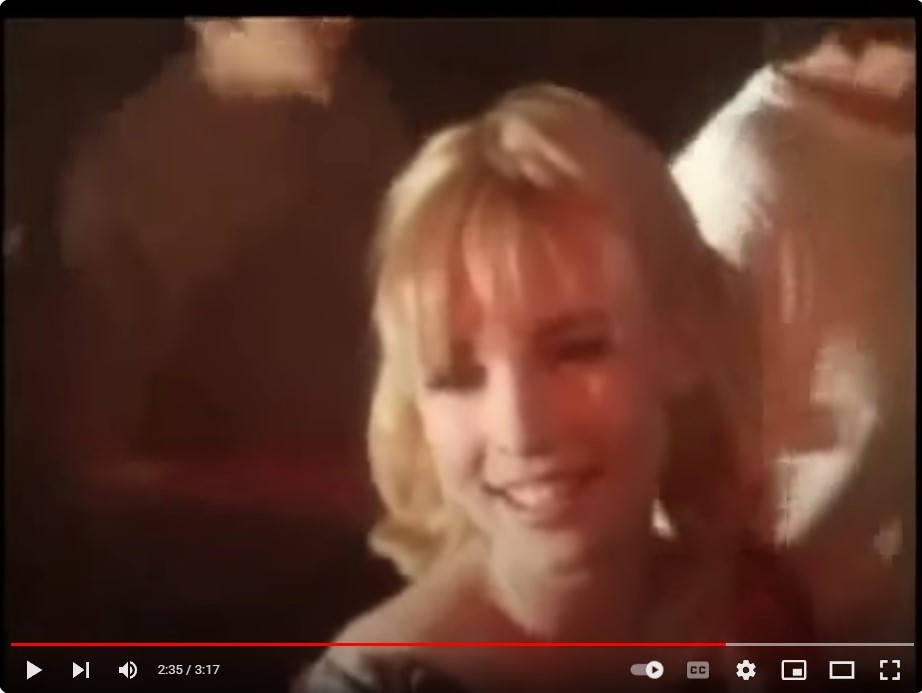
Which again brings everything full circle. One thing that links all three of these videos***** is the standard set-up of the band playing their song on a soundstage, often oblivious to all the complicated concepts and shenanigans that make up the rest of the video. This anchor shot of Crenshaw and his band playing has been weaving in and out of the “Whenever You’re on My Mind” video thus far, and that’s where we end up, at the gig, where of course the bartender wanders in for the show. This is a woman who just radiates confidence and a magnetic (but not video-clichéd) sexuality. She walks right to the front of the stage, smiles, and waves to Crenshaw, which gives way to a brief montage of her four different appearances in the video. Back to the concert hall, and with Marshall now oblivious to everyone in the audience (comprised solely of young kids, amusingly) except her, the rest of the audience indeed dissolves out of the image. I threw out the idea that the Undertones video might be somebody’s daydream; that possibility seems to be the very foundation of “Whenever You’re on My Mind,” both song and video.
It seems to be, but can it be, a fantasy?
It seems to be a reverie, you’re here with me
Whenever you’re on my mind
Whenever you’re on my mind
I leave the world behind
Whenever you’re on my mind
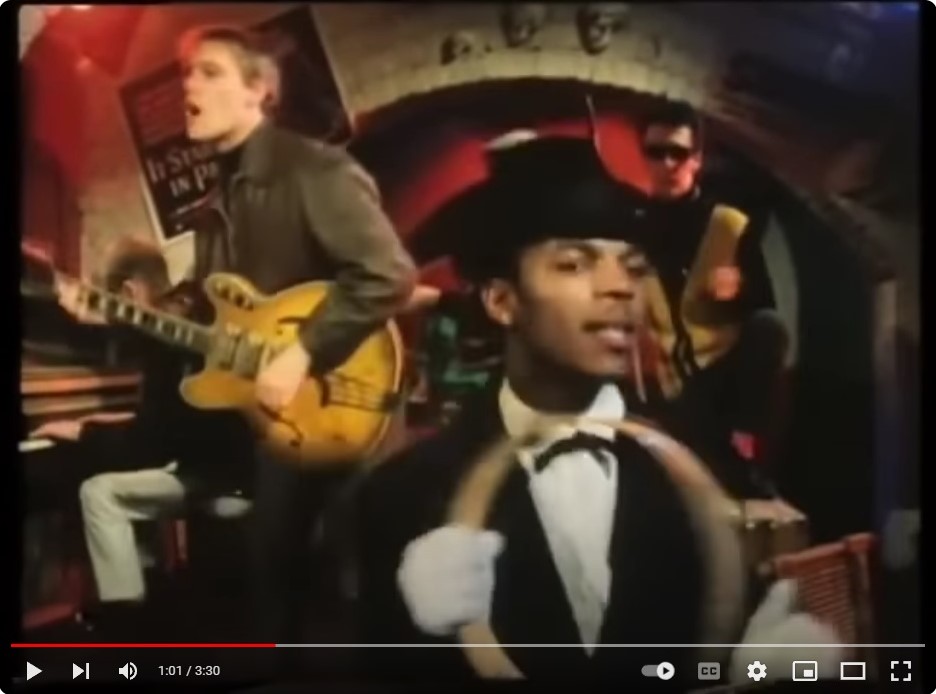
The Beat’s video for “Save It for Later” starts on that ubiquitous soundstage, Dave Wakeling wearing a leather jacket and dressed in the manner of present-day, but maybe not; the camera pulls back, and we’re inside what looks to be a Left Bank cafe out of the 1950s, patronized by a mix of book-devouring (pseudo-?) intellectuals in turtlenecks, dice-rolling sharpies, beret-wearing sketch artists, and the enigmatic women who gravitate to such characters. Interest in the Beat, as the video begins, is minimal; one of the literary contingent shakes his head dismissively and goes back to his book, another puts in ear plugs. (Four or five different books are held aloft. The image is a little blurry on YouTube, but I can make out Orwell’s Nineteen Eighty-Four, an English translation of Marx’s Das Kapital, and–one I’ve never heard of–Françoise Sagan’s Aimez-vous Brahms?)
From there, the story is neither as intricate as in Crenshaw’s video nor as absurd as in the Undertones’: it’s just a matter of the Beat getting this highbrow audience to loosen up and start dancing. It’s like an early Alan Freed film flipped on its head: instead of the stodgy old parents coming around on rock and roll (“You know, it’s really not that bad…”),****** the Beat has to convert an audience of self-appointed hipsters. So about 1:20 into the video, Wakeling jumps down from the stage and gets at it. He wisely starts with one of the women, and before long–the video runs under four minutes, so he has to work fast–everyone in the room joins in: the sketch artist, the Marx guy, even the ear-plugged Sagan reader (who takes a decorative skeleton for a quick spin).
Wakeling–along with Ranking Roger, looking incredibly cool in a black fedora, and the rest of the Beat–doesn’t have to do much; “Save It for Later” does most of the work. I’m a ‘70s guy who says unkind things about the ‘80s whenever I get the chance. Very few of the decade’s biggest hits or most iconic songs mean a thing to me today, while much of the music I love from the ‘80s (and there’s lots) never got near MTV or the radio. “Save It for Later” is an exception. It fills me with a happiness so overwhelming, I want to go back there and relive the whole dreary decade, maybe come to understand what I missed the first time. I’d like to start off inside this video, in this fictitious cafe, dancing to “Save It for Later.”
*Friends tell me that the Beat, especially as a live draw, were much bigger than Crenshaw or the Undertones. The American charts don’t really reflect this–Crenshaw had one single, “Someday, Someway,” barely creep into the Top 40 but no albums; the Beat reversed that–but they may be right.
**And, in the United States at least, really didn’t take when Virgin tried to do the same with Undertones lead singer Feargal Sharkey in 1985 (“A Good Heart” was a big hit in the U.K. and Canada).
***Pretty sure I didn’t personally destroy anything, but I did get to jump onstage during the Clash’s encore and stand a few feet away from Joe Strummer.
****One of those biases I carried around for years, until I stopped one day and started thinking about all the exceptions. “Well, I like that, and this is also pretty great, and wow, I love that,” and on and on from there. Maybe it’s just trumpet and French horn I love, and they’re different from the kind of brassy, bombastic brass I don’t like.
*****Along with a more obvious link between two of them, another belated discovery as I track down director credits months later: the Undertones and Beat videos were both directed by Julien Temple, best known in the film world for The Great Rock ‘n’ Roll Swindle (1979) and Absolute Beginners (1986).
******I’ve made the same contrast between Richard Linklater’s School of Rock and the earliest rock and roll films–except there, it’s Jack Black’s straight-arrow classroom of 12-year-olds who have to be made to see the light.
 we don't want to know