People were posting about Liz Phair on the I Love Music message board a couple of weeks ago. Whenever a name from the past resurfaces on ILM, it’s almost always attributable to one of three reasons: 1) new music from someone in whom interest has declined enough that an old thread is resurrected because no one can be bothered to start a new one; 2) death; or, 3) increasingly a marker of the moment we live in, someone has said or done something impolitic, maybe even criminal, that has been greeted with widespread opprobrium. The Liz Phair posting fell into a fourth, more general category that sometimes resurrects threads: she’d been playing some club dates, and people who’d seen her just wanted to say how great she was.
I count Phair as one of four women who, during the 1990s, went from the pinnacle of critical acclaim–through the ‘80s and ‘90s, the Village Voice’s yearly Pazz & Jop poll was a convenient way to measure that (nothing as broad-based has come along since to replace it)–to a career that drifted into confusion, poor timing, bad luck, and an inability to ever match her initial flourish of success. One of the four, Sinéad O’Connor, I’ve already posted about; another, Courtney Love, I’ll get to later on. Which leaves Phair and Lauryn Hill. Phair’s Exile in Guyville (1993) and Hole’s (the band led by Love) Live Through This (1994) both topped their year’s Pazz & Jop album list; O’Connor’s I Do Not Want What I Haven’t Got (1990) and Hill’s The Miseducation of Lauryn Hill (1998) were runners-up. What happened after that, the nuances and blatant double standards of gender and race that complicated their stories, is a matter peripheral to the two videos I’m writing about here.* There’s a book right there, if anyone wants to write it. But, short version, I think it’s fair to say that these four women encountered much more resistance–from critics, from radio and MTV, and from listeners–than any number of men in comparable situations.**
David Speranza’s video for “Divorce Song,” posted on YouTube in 2009, may have been the first homemade video I ever took notice of. His accompanying note:
Unofficial take on the great Liz Phair tune, starring Cheyanne Racey on a rooftop. First attempt at a music video, done mostly for fun, back in 2002. Shot on a Sony TRV900 miniDV camcorder (remember those?).
For the longest time, after I linked to it for a Facebook countdown I mentioned in an earlier post, the video seemed to disappear; possibly Speranza was ordered, by either Phair or her record company, to take it down, or it was hiding out for a few years under a different title. I’d like to think somebody at Matador Records finally realized that someone had done their work for them, and more creatively than they would have themselves if they’d bothered to try (no official video exists for “Divorce Song”), and contacted Speranza to repost it. It’s been viewed all of 649 times as of today.
“Divorce Song” is a woman’s recounting of a road trip and a relationship gone very bad. When I wrote about it at the time in Radio On, I heard the song as Five Easy Pieces–Bob Rafelson’s definitively early-‘70s account of Robert Dupea (Jack Nicholson), a privileged, moderately talented classical pianist drifting through life–told from Rayette’s (Karen Black) point of view. I still do, along with echoes of Barbara Loden in Wanda, Carrie Snodgrass in Diary of a Mad Housewife, Barbara Harris in Nashville, and every other ‘70s female character from the movies who spends inordinate amounts of time listening to her husband or boyfriend drone on and on, often while sitting silently in the front passenger seat of a car. (To be fair, in Five Easy Pieces it’s more often that Nicholson listens to Black drone on and on: “If you wouldn’t open your mouth, everything would be just fine” he tells her in bed one night. That you may remember it the other way around says everything you need to know about who controls their relationship.)
Speranza’s “Divorce Song” video takes place on a city rooftop, not in a car, and it’s just Cheyanne Racey, without a male in sight. Sometimes she’s lip-synching along to Phair (for the first minute, presumably singing aloud with what she’s hearing over the headphones she wears; the headphones mysteriously disappear after that) and sometimes she’s silent; sometimes she’s moving and sometimes she’s still; sometimes her eyes are cast downward and sometimes she meets our gaze. When she’s silent or looking downward, you feel the belittlement and feelings of shame and insignificance that Phair endures in “Divorce Song;”*** when, every now and again, she looks up and stares out at you, the suppressed rage that Phair hints at (“burn it up and throw it away”) is made abundantly clear.
So why a rooftop? Well, I’m sure budget was the primary consideration, but it’s also a setting that allows Racey to roam around, to dance or jump or punch inanimate objects (like the white pipe she whacks at 2:13) as the mood strikes her, with the windows and rooftops of the surrounding buildings making for a nice backdrop. Phair sounds hopelessly trapped in “Divorce Song,” and when she counsels herself**** to “take a deep breath and count back from ten/and maybe you’ll be all right,” it sounds like she doesn’t really believe her own advice–you can feel her resignation that this horrendous situation she’s in will never change. The video opens the song up, playing off the claustrophobia of Phair’s song against movement and space. “You put in my hands a loaded gun/And then told me not to fire”: another dead end in the song, but Racey fires. And it’s liberating.
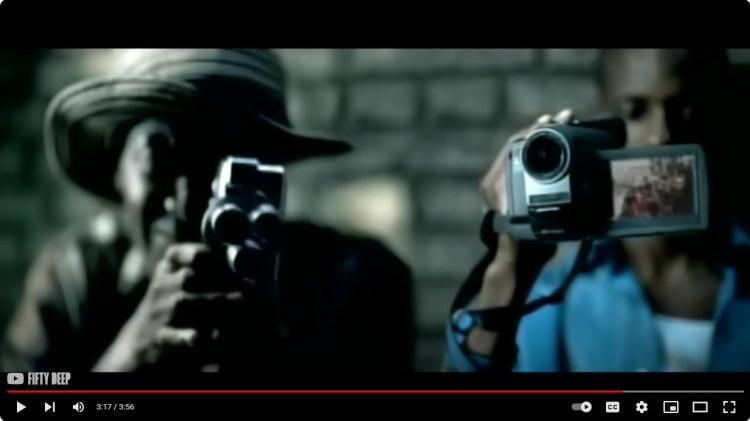
Lauryn Hill’s video for “Doo Wop (That Thang)” also begins on a rooftop–two rooftops, actually, the most salient feature of Monty Whitebloom and Andy Delaney’s video being their use of split screen from start to finish. I was trying to think of some other well-known music videos that use split screen, and the two that occurred to me–Hole’s “Miss World” (because of the film it pays tribute to, Brian De Palma’s Carrie) and the Beastie Boys’ “Sabotage” (because it seems like it ought to)–well, I’m misremembering both; neither uses split screens. A Google search turns up videos by Destiny’s Child, Robin Thicke, the Kills, and Cassius, none of which I remember and quite likely never even saw. In the movies, split screens are almost always used to establish simultaneity, often to heighten the tension in a thriller or action film where two parallel sequences of events converge. In Carrie, we watch Sissy Spacek on stage while Nancy Allen and Amy Irving clash in the shadows; we know that Carrie is about to be subjected to the most humiliating moment of her life, and our foreknowledge leaves us both helpless and (the Hitchcock touch) complicit–we want to see that bucket fall. “Doo Wop”’s split screen is after something entirely different: the visual pleasures of symmetry, with two mini-narratives unfolding that perfectly mirror each other 31 years apart. Both halves of the screen are set in New York’s Washington Heights neighbourhood; it’s 1967 on the left-hand side, 1998 on the right. And a fundamental truth about the world has not changed: be extremely careful when it comes to “that thing” (less sex itself than the obsessive preoccupation with and pursuit of it), because whether you’re a man or woman–Hill’s song is primarily aimed at woman, but she does counsel both sides, and doesn’t let herself off the hook, either–it will catch you up and grind you down.
Looking back on what I wrote about “Doo Wop” on my Pazz & Jop ballot that year (it was my #1 single), I can see that I very much heard Hill’s song as a snapshot of the Clinton-Lewinsky moment:
“That thing” is a good name for that thing. That thing uses up an incredible amount of time, energy, and creativity. It brings down sportscasters, pop stars, football heroes, film directors, and presidents, and if I haven’t yet had my own life fall apart because of it, it’s not for lack of trying.
The sportscaster was Marv Albert, the pop star Michael Jackson or George Michael or one of probably a half-dozen other candidates, the football hero O.J., and I can’t remember what film director was in the news then. (The last part of that, we can skip; I sometimes over-dramatize. I’m still here.) I also made note of what struck me as a contrast between Hill’s “badgering and hectoring,” and the “sweetness and light in the chorus and the two notes that carry the song along.” Today, I don’t hear the lecture at all, just preternatural wisdom: how does this 23-year-old woman know more about the world than I do (at 37, then, and, 25 years later, at 62)? And it’s the sweetness and light that the video emphasizes: summer block parties, dancing, hand-holding, and Hill looking uber-stylish in a beehive (left screen) and as her natural self on the right. If you weren’t listening all that carefully to the lyrics, you might think the song is as much a celebration of community and neighbourhoods as D.J. Jazzy Jeff & the Fresh Prince’s “Summertime” (not that it isn’t that too). The then-and-now of technology is also illustrated subtly via the split screen: transistor radio next to a portable cassette player, super-8 camera alongside a camcorder, a mic stand on the left and a handheld mic on the right. I can see where one line would cause Hill some trouble today (I recall that it was a minor issue even then): “Fake nails done by Koreans.” But it seems clear enough to me that her problem is with the fake nails, not who’s servicing them.
“Watch out watch out/Look out look out,” the two Lauryns harmonize, sounding almost like the Julie Ruin. They’re warning you, warning each other, maybe even warning the woman in Liz Phair’s “Fuck and Run” (I won’t assume it’s Phair herself), whose enslavement to that thing has led her to a sad flash of awareness: “I’m going to spend my whole life alone.”
*Not entirely, of course, it couldn’t be: “You wonder why women hate men?” Hill asks/taunts in “Doo Wop,” a question that’s there in Cheyanne Racey’s eyes throughout the “Divorce Song” clip.
**Why I don’t like theorizing like this, and why I’m not good at it: 1) I can come up with other plausible explanations for each woman’s commercial/critical decline; 2) the list of Pazz & Jop winners also includes Graham Parker, Arrested Development, TV on the Radio, and Animal Collective, all of whom started to fade to one degree or another afterwards; 3) the year Lauryn Hill finished second, ahead of her at #1 was Lucinda Williams’ Car Wheels on a Gravel World.
***Brilliant: “When you said that I wasn’t worth talking to/I had to take your word on that.” Not to shortchange “Divorce Song”’s driving, rough-and-tumble instrumental track, but it’s one of those songs where I want to start quoting line after line, never the best way to write about pop music.
****Open to interpretation. Maybe she’s talking to her partner there; I think the words are meant for herself.
 we don't want to know