Among the hundreds and hundreds of YouTube clips I played for my grade school students over the years, two of my favourites were documentary footage of famous painters: Pablo Picasso from Henri-Georges Clouzot’s The Mystery of Picasso (the entire film was on there for years, but it’s only available as a rental now) and Jackson Pollock from Hans Namuth’s Jackson Pollock 51 (for now, at least, the whole 10-minute film is viewable for free). Clouzot’s film was made in 1956, a few years after Namuth’s. “This is pretty amazing, when you think about it,” I’d tell the class; “Picasso and Pollock came along after the invention of the movie camera, so we can actually watch them paint. We can’t do that with Leonardo Da Vinci.” They didn’t seem to find that as wondrous as I did, but I really looked forward to showing the clips anyway.
Not exactly the same thing–you see the work, not the artist–but with Andy Warhol still alive well into the 1980s (he died in ‘87), we can similarly say that Warhol actually made a music video. Three in fact–and not obscure, never-meant-to-be-seen-outside-of-an-art-gallery vanity larks, but commissioned works that were intended for maximum airplay on MTV. The Cars’ “Hello Again” (1984) and, to a lesser extent, Ric Ocasek’s “True to You” (1986) and Curiosity Killed the Cat’s “Misfit” (1987) were hit singles and MTV-ready videos. Don’t take the latter as a compliment–“Hello Again” is as garish, as ugly, and as preposterous as so many other ‘80s videos I find unwatchable, the kind of claptrap Beavis & Butthead used to stare at uncomprehendingly (notwithstanding Warhol’s own amusing cameo as a lip-synching bartender; Garbo talks, Warhol lip-synchs–perfect). Did Warhol create “Hello Again” at an ironic remove, as a dry comment on the very iconography he would appear to be emulating? Doubtful–it feels more like he’s haplessly trying to keep up with the times.
Which was quite unnecessary. In the mid-‘60s–and beyond, but especially from 1963 to 1966–Warhol made films that would exert long-term influence on not just cinematic language but also, inevitably, the tangential course that music videos would take. To a certain extent, he was playing catch-up with himself in the three music videos he directed in the 1980s, especially, I’d say, with the series of Screen Tests that were shot in the Factory during those years (over 500 of them, the first in 1964 and continuing through 1966). I say “shot in the Factory” rather than “directed by Warhol,” as his participation began and ended with setting up the camera and then remembering to turn it on. Check that–according to Wikipedia, verbal instructions were also issued: “The subjects were generally directed by Warhol to hold perfectly still and not blink for the three-minute duration of the filming.” In fewer words than the 21 that comprise that sentence, I’m guessing.
The Screen Tests I’ve seen–two or three dozen, most as part of the “Andy Warhol: Stars of the Silver Screen” exhibit at Toronto’s Lightbox in 2015; a few are available on YouTube–are as disarmingly beautiful as anything I’ve ever encountered on film. Such a claim might seem puzzling in view of the description above (“Okay, camera’s running, now go”), but to watch Warhol’s subjects stare out at you in perfect silence–passively, disdainfully, coyly; maybe enjoying some private joke, or in one instance famously shedding a visible tear–is to confront some deep well of mystery that exists outside of Warhol or the world he’d constructed or the fabled 1960s. You could spend your whole life trying to figure out what exactly it is that transpires in that space, but it does feel like whoever’s looking out from the screen–Dylan, Susan Sontag, Edie Sedgwick, Dennis Hopper, Lou Reed–knows much more about you than you do about them, and that’s all right. It’s not an uncomfortable feeling. A friend and I were talking about Warhol’s Vinyl, his rather loose adaptation of A Clockwork Orange, and we wondered whether Warhol knew that half a century later people like us would still be trying to figure out why the film felt so sinister and violent–much more so than Kubrick’s version, I’d say–or whether he’d forgotten about the whole thing two days later. Maybe a little of each, but we both came down on the side that this was someone who was consciously after something permanent.
Same with the Screen Tests: seemingly created wholly from some combination of chance and indifference, I think they were works of careful deliberation and the utmost seriousness. Conceptually, at the very least. These days, the subjects of the Screen Tests don’t always stare out at you in perfect silence; the post-internet world being what it is, people have of course taken it upon themselves, both legally and illegally, to add music to Warhol’s work. I’ve seen Dylan’s Screen Test accompanied by the Velvet Underground’s “Heroin,” by one of Dylan’s acoustic demos for “Like a Rolling Stone” (removed, but I saved a copy), and, I swear–it’s also been taken down, and I didn’t save a copy–by “I’ll Keep It with Mine” (Dylan’s original). They’re all great to one degree or another–how could they not be? Other Screen Tests watchable on YouTube with musical accompaniment: Nico’s (“All Tomorrow’s Parties”); a mix of Dennis Hopper’s, Edie Sedgwick’s, Lou Reed’s, and a few others’ (New Order’s “Ceremony”); Freddie Herko’s (Ash Ra Tempel’s “Le berceau de cristal”); Ann Buchanan’s (music by James Longcake, the guy who posted it; Buchanan’s is the Screen Test where you see the tear); Kip Staggs’ (unidentified music for the first 90 seconds; the remaining 2-1/2 minutes are silent); and I’m sure others that are hidden away under artful titles. They would all seem to have been created and posted without permission, up there for as long as it takes the Warhol Estate to get them taken down.
Which leaves at least six that are, presumably, 100% authorized, all produced as part of the Dean & Britta album 13 Most Beautiful: Songs for Andy Warhol’s Screen Tests (2010): Edie Sedgwick’s (“It Don’t Rain in Beverly Hills”), Baby Jane Holzer’s (“Knives from Bavaria [Spoonful of Fun]”), Paul America’s (“Teenage Lightning and Lonely Highways”), Susan Bottomly’s (“International Velvet Theme”), another 14-minute mix of Hopper’s and two others (three songs: “Richard Rheem Theme,” “Herringbone Tweed,” and “Incandescent Innocent”), and, the one I most love, Mary Woronov’s backed by “I Found It Not So.”* The Wikipedia page for the Screen Tests lists 52 of the participants by name, with links to their own Wikipedia pages; Woronov isn’t one of them, even though to me she’s more well known today than many of the people who are (Piero Heliczer, DeVeren Bookwalter, a few others). If nothing else, you’ll know Woronov as Principal Togar in Rock ‘n’ Roll High School (“Do your parents know that you’re Ramones?”). She also delivers one of the more memorable harangues in The Chelsea Girls.**
Long before Principal Togar’s cartoon villainy, Woronov’s Screen Test begins–and largely stays fixed on–a classic Kubrick Stare. Her eyes occasionally drift left or right, 30 seconds in she gives her hair a quick shake, and the very definite outline of a smile appears near the two-minute mark (with an actual smile at 3:40). If you quickly slide your cursor through the video’s four-minute running time, Woronov doesn’t seem to reposition herself more than a few inches to the left or right, as opposed to the way Dylan is always bobbing, weaving, and shifting throughout his Screen Test. Dylan wants to dodge the camera at every turn–he’s bored, and he loathes Warhol. Woronov wants to possess the camera, dominate it, and dominate you. But again, it’s not an uncomfortable feeling, not in the least. It’s spellbinding.
And, of course, there’s Dean & Britta’s “I Found It Not So” as musical accompaniment. In trying to place the song on the remarkably eclectic Velvet Underground spectrum–“Sister Ray”’s cacophony, the drone of “Lady Godiva’s Operation,” “Rock and Roll”’s propulsive sweep, the sweetness of “After Hours”–I can’t, not really, and that’s part of why it works so uncannily: it forces you to experience Woronov’s Screen Test in a new way that (to pick a VU song that more obviously matches her glare) “Venus in Furs” wouldn’t have. “I Found It Not So” is an ethereal wisp of dream-pop that owes more to Dean Wareham’s first band, Galaxie 500, than to the band he subsequently fronted with Britta Phillips, Luna.
I’ve been dreaming of your hair
And your skin so soft
Let’s go away from here
Where the doors can all be locked
So “After Hours” in spirit, still in search of the ecstasy hidden behind that closed door, but far removed from Maureen Tucker’s plain-Jane delivery. I’m certainly not going to say that “I Found It Not So” is better than “After Hours”–a song that single-handedly trumps, to randomly choose a verb, whatever feelings I might have about Tucker’s later-in-life political inclinations; falling helplessly and forever in love with the Maureen Tucker of “After Hours” is part of being a Velvets fan–but it’s the right song here.
If we go back a few months before Woronov’s Screen Test, we’re back where we started: Nico actually made a music video–nothing to do with Warhol (not sure if they even knew each other yet; the Velvet Underground wouldn’t perform publicly for another year), not something that dates to the early days of new wave and MTV-style videos, but a real music video from 1965. I’ll have a few later on–they were thought of as promotional clips then, no different in intent than a radio spot, and they would have been played on Top of the Pops-type television shows.*** Nico was already a Vogue model, sometimes actress (she memorably appeared as herself–“Nicolina!”–in Fellini’s La Dolce Vita), and emerging international jet-setter when she recorded Gordon Lightfoot’s “I’m Not Sayin’,” beating Lightfoot himself to it. (It would appear a year later on his debut album.)
We’re light years away from the Screen Tests here. Nico–whose aloof, mysterious visage of legend suggests someone who has never set foot outdoors, or at least not before 10:00 p.m.–is out and about in the world, hanging around the West India Dock Pier on the River Thames, strolling across bridges, watching ferries pass by.**** There are a couple of brief close-ups, but mostly we see her in medium- and long-shot; the locale gets more of the camera’s attention than she does, although–we’re talking about Nico here–your eye will quite likely be drawn to her. The mood is very 1965, sunshiny folk-pop for the limitless optimism of the new, post-Beatles pop landscape. I don’t know how resonant the clip would be without the context of everything we know about Nico’s incredible career path afterwards, but as is–and even in the age-worn and somewhat blurry version I’m watching on YouTube*****–the sadness of the afterwards adds just the right note of melancholy to the buoyancy of the moment.
I began this entry by saying that Warhol influenced the course of music video, an assertion that is a) based on the possibility that Warhol influenced just about every work of visual art since 1965, and b) the kind of thing pop and rock critics reflexively say. In actual fact, I don’t know how true that is. I’d like to think the Screen Tests had something to do with the conception of Sinéad O’Connor’s video for “Nothing Compares 2 U,” but I know that Carl Dreyer’s The Passion of Joan of Arc is really the guiding template there. There’s at least one video, though, that is unmistakably not merely influenced by the Screen Tests, but an attempt to pay homage by way of recreating them: R.E.M.’s “We All Go Back to Where We Belong,” their very last video (and single) before breaking up in 2011.******
Two videos, actually: there’s one version with John Giorno, and an entirely different one with Kirsten Dunst. The latter wouldn’t be my first choice for a Screen Test-styled video–I associate Dunst with the kind of klutzy energy she brought to the Bring It On movies and Dick; Nicole Kidman would have been perfect*******–but, a little older than she was then, she settles comfortably into the easy grace of R.E.M.’s song. The Giorno version, of course, needs no such explication. He is the thing itself (“the thing” being the cast of characters wandering through the Factory in 1965 and 1966): Warhol’s boyfriend for a time in the early ‘60s, the star of Sleep (1964, one of Warhol’s first films to attract a lot of attention), and, as you might expect, subject of one of the original Screen Tests. Is Giorno thinking about his time with Warhol and his life at the Factory–all of it half-a-century gone–as he sits there for the R.E.M. video? For most of the clip’s duration his dreamy stare is fixed off-screen to his left, but two or three times, and right at the end, he breaks into a broad smile. Giorno was in his seventies when “We All Go Back to Where We Belong” was made (he would die in 2019), so the clip feels as elegiac for him as it does for R.E.M–as if, in a very real sense, he has gone back to some distant but remembered place where he belongs.
*Not sure why there’s not a corresponding video for every song on the Dean & Britta album; I would have thought that was the whole impetus for the project, to take an existing Screen Test and layer music overtop.
**Woronov was all over Todd Haynes’ generally excellent 2021 documentary The Velvet Underground, at one point superciliously–and rather cluelessly, I’d say–issuing a blanket dismissal of everything coming out of the West Coast in the mid-‘60s as hippie fluff.
***Not to be confused with hundreds of short music films from the first half of the ‘60s that were produced to be played on Scopitone jukeboxes. There’s no listing for Nico in the Scopitone Archives’ (https://scopitonearchive.com/index.html) extensive list of these video forerunners, so I’ll assume “I’m Not Sayin’” was shot as a promotional clip. I’m not sure if the distinction is important.
****There’s an early video for Tom Rush’s “No Regrets”--colour, rather than “I’m Not Sayin’”’s black-and-white–that is very similar conceptually and in its setting. I could have just as easily chosen to write about that.
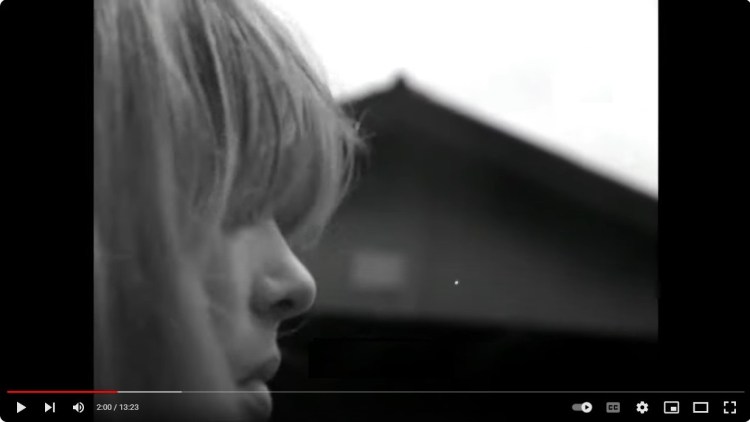
*****Just today I’ve discovered a second clip for “I’m Not Sayin’,” which runs over 13 minutes and includes parts of the video (with a much sharper image, and sequences that were edited out), a couple of minutes of Nico lip-synching the song in-studio (dramatically back-lit and not all that unlike an actual Screen Test), and a collage of still photos, posters, and various period images. The audio is split between “I’m Not Sayin’” and its B-side “The Last Mile,” produced by Jimmy Page.
******There are so many R.E.M. videos I love that I thought twice about including this one, but the fit is too perfect. Otherwise, I’d be writing about “The Great Beyond” or “Man on the Moon” or “It’s the End of the World as We Know It (And I Feel Fine).”
*******Pursuing this thought, if someone ever makes The Mary Woronov Story, Kidman would be perfect for that, too.
 we don't want to know