Another day, another widely-discussed* list–that’s partly what this entry is about, but mostly it’s Kurt Cobain who links these videos together. I missed the 30th anniversary of his death early in April, though–I was in the middle of the Arrested Development/Outkast entry–so I’ll start with that list: Apple Music’s Top 100 Albums. First question: didn’t the iPod go out of production a few years ago? And if there’s no iPod, wouldn’t that have meant the end of Apple Music too? I’m always one or two technological revolutions behind. Or seven or eight–this is a blog about music videos.
None of the three artists I’m writing about here are on the list. Two of them should be, even (or maybe especially) in the context of self-consciously trying to overturn the canon.** The other, not a chance. And then there’s Nirvana, who, unsurprisingly, are on there with Nevermind, which by now is far more entrenched as part of the canon than as part of the overturning. Which it was, to a degree, somewhere along the way. As I often say about lots of things: who can keep track anymore? I’m not going to launch into some anti-canon, anti-list diatribe here. It is absolutely a small cottage industry these days that extends far beyond Rolling Stone, but, just as with the obituary industry (cf. Sinéad O’Connor post), I’m complicit whenever it suits me, and have been for almost 40 years, when I used to contribute little lists to a Canadian monthly called Graffiti. I won’t recount my entire list-making history–I probably have already somewhere, maybe even in the form of a list–but, just since Pazz & Jop went under in 2019, I’ve taken part in the following:
- a list of my 50 favourite songs for rockcritics.com
- my favourite songs of the 2010s (also for rockcritics.com)
- my favourite films of the 2010s for my homepage
- my 30 favourite films ever for an ILX poll
I ended You Should Have Heard Just What I Seen with a round-up of my 109 favourite pop-music moments in a movie or TV show. The entries were alphabetized, not ranked, and I intentionally listed a weird non-multiple of 10, but a list it was. When I turn this blog into a book, I could easily drop a couple of entries and call it We Don’t Wanna Know: The 50 Greatest Music Videos Ever Made. Which would surely get me onto the New York Times’ bestseller list, but I’ll stand my ground and resist.
Anyway, all I get from the Apple list is a second question: who, in 2024, are these lists for? I knew who Paul Gambaccini’s Critics’s Choice: Top 200 Albums was for when I bought it sometime around 1980: it was for me, a just-getting-started record collector who wanted to have all the most important albums in my collection, and also someone who took an interest in rock criticism and the quirky tastes of the people I read (and who maybe wanted to try my own hand at that eventually). Even 10 years later, when Spin published what was, to my mind (maybe I missed something), the first attempt to blow everything up–their greatest-ever singles (Rob Base’s “It Takes Two” at #1) and albums (James Brown’s Sex Machine ditto–and Prefab Sprout at #22!) lists in their April 1989 issue–it still felt like I was more or less the intended audience. Today, I have no idea. Do people in their twenties who stream music on Spotify care about building a collection? (A collection of what?) Are there Tik Tok-era teenagers out there who are thinking “I’d like to be a rock critic–I should go take a look at this Apple list”? The most obvious answer is that it’s still–more less than more now–meant for me. I’m not posting about it in a Substack, and I’m not doing any podcasts on it–not yet, anyway; you never know–but I’m writing about it here, so I am engaged. When you get down to specifics, though, and I start perusing the list (excellent graphics right on the Apple site, by the way–the albums fly by in the air as you scroll through), it’s like “okay, okay, huh?, sure, ridiculous, ridiculous, who?, okay, and oh, look, the Arctic Monkeys are lodged between Exile on Main Street and the first Velvet Underground album…” Ever more arbitrary, ever more unmoored from any sense of “OK–this makes sense.”***
The absence of Sonic Youth makes no sense. They were made for canonical lists (#9 on Spin’s “100 Alternative Albums” from 1995–I could go on), and they were made for music video. Coming, as they did, out of the same Lower East Side milieu that was home to filmmakers Jim Jarmusch (early Sonic Youth member Richard Edson personified the goofier side of late ‘80s bohemian cool in Jarmusch’s Stranger Than Paradise), Scott and Beth B, Nick Zed, and many others, it’s not surprising that SY’s music lends itself extremely well to the form, whether official videos produced by the band or appropriated footage assembled after-the-fact by fans. When they’re not gratingly noisy, they’ve regularly made music that feels “cinematic”****–elliptical, spacious, lost somewhere in a twilight horizon of endless purple…the cover of Bad Moon Rising, in other words; that’s what one kind of good Sonic Youth video looks like. Some good ones that capture that mood: “I Dreamed I Dream” (at least two different ones, with images lifted from the films of D.A. Pennebaker and Godfrey Reggio), “Shadow of a Doubt,” “Kotton Krown,” “Theresa’s Sound World.” Two others I like a lot that are very different: “Sunday” (weird–and sometimes creepy–joking around with Macaulay Culkin) and “Kool Thing” (Kim Gordon all hopped-up on glam and Edie Sedgwick).*****The video for “Teen Age Riot,” directed by the band itself, shares in “Kool Thing”’s propulsive flash, and it also anticipates the tutorials Jack Black puts together for his class in 2003’s School of Rock. But most of all–why it’s here–it’s dreaming of Kurt Cobain.
Looking for a man with a focus and a temper
Who can open up a map and see between one and two
Trying to precisely and authoritatively reconstruct anything about pop music in 1988–in this case, the state of guitar-based, punk-leaning rock and roll (how’s that for vague description?)–from the vantage point of 2024 is impossible, of course; everything is always in flux, and every theory is coloured by subjectivity. So when I say that the world Sonic Youth came out of felt dead in 1988,****** that’s how it felt to me; if you thought Guns N’ Roses was the greatest guitar-based, punk-leaning rock and roll band since the Sex Pistols, it was a thrilling time to be alive. What I can say, though, if I’m hearing “Teen Age Riot” correctly, is that Sonic Youth (the entire band gets the songwriting credit) felt as if something central to who they were was starting to slip away. They’re starting to slip away too–“it takes a teenage riot to get me out of bed right now”–but they’ve got their radar up, and even though it’s like they’re singing in code sometimes, assembling a jigsaw puzzle out of secret locations and clues, when the moment arrives, they’ll know.
Here he comes now
Stick to your guns and let him through
The song “Teen Age Riot” tentatively looks ahead; the video is more of a eulogy, an inventory of the slipping-away. I don’t recognize everyone who turns up–much of what you see is drastically over-exposed; there’s a full list of everyone on Wikipedia–but in a series of little snippets, you get a chronologically jumbled, whirlwind tour through the history of punk rock: X, Patti Smith, the Butthole Surfers, Mark E. Smith of the Fall, Kiss (!), Andy Kauffman (!!), Henry Rollins, Dennis Wilson, Sun Ra, Iggy Pop, Neil Young, and many others, everything anchored by recurring footage of Sonic Youth themselves in front of an American flag and flailing away at something. Punk-rock is not supposed to be elegiac, nostalgic, wistful, or anything like that–it’s supposed to abhor and stomp all over such sentiments–but that’s what “Teen Age Riot” is when heard as backdrop to that roll call, especially riding on a melody that is, for Sonic Youth, unusually accessible and major-key-ish (or maybe one of their dissonant tunings that was so complicated they accidentally ended up there).*******
Sonic Youth’s Daydream Nation, led off by “Teen Age Riot,” was released on October 18, 1988; Nirvana’s first single, “Love Buzz” (a Shocking Blue cover–maybe they were dreaming of Bananarama), came out a few weeks later, and the story (if there actually is a story; we like stories, so sometimes we make them up where none exists) went on from there. In both directions, so let’s backtrack a bit first.
In March of ‘88, before Sonic Youth even stepped into the studio to begin Daydream Nation, the Vaselines, a little-known band out of Scotland, followed up their first single (1987’s “Son of a Gun”) with the four-song EP Dying for It. It seems like the ultimate in what-we-do-is-secret records, but I’m guessing that Thurston Moore, being kind of a geeky, record-collector type, probably was aware of the Vaselines.******** I’m kind of a geeky, record-collector type myself, but I didn’t learn of them until approximately 15 years later, when I downloaded Sub Pop’s The Way of the Vaselines: A Complete History in my early days of binge file-sharing. The important thing is that Kurt Cobain definitely knew of them–Dying for It is listed as one of Cobain’s 50 favourite albums in a widely-circulated handwritten list he compiled for his journals. (Daydream Nation is also in there.) To underscore that, Nirvana went on to cover two of Dying for It’s four songs: “Molly’s Lips” in 1992 (found on Hormoaning, an import EP, and the loose-ends compilation Insecticide), and an acoustic “Jesus Wants Me for a Sunbeam” on their MTV Unplugged album in 1994. There’s a chance I may have encountered the latter on MuchMusic at some point, but I wouldn’t have known anything about the Vaselines yet. I definitely hadn’t heard their “Molly’s Lips” cover–sprightly Nirvana buzz, nothing more–and, I think, would have quickly forgotten it if I had.
You can find (user-created?) videos for the two Vaselines originals posted on YouTube. Picking one over the other to write about here is a veritable coin-flip. The “Jesus Wants Me for a Sunbeam” clip, uploaded by agriokuparissi in 2011–48,000 views and zero comments, which makes no sense at all–lays the song overtop old found footage from the ‘50s or thereabouts of adolescent girls engaged in various schoolyard games: jump-rope, mostly, but others that are ball-related, and also some Ring Around the Rosie. Everything starts on what appears to be actual school grounds, then, two minutes in, relocates to one of those bombed-out areas of London characteristic of the era. The final half-minute abruptly leaps back to the earlier part of the century. A young girl sits in a chair nuzzling and feeding her kitten, soon joined by a young boy who looks like he’s there to perform magic but doesn’t. They shake hands, the boy doffs his hat a couple of times, and that’s it. The only overt suggestion of Jesus or religion I can see in the entire video is one of those schoolyard girls placing her hands in prayer at the 42-second mark while she skips rope. Shadows are prominent: fence railings, legs, entire silhouettes.
It’s a video that leaves me pondering questions I can’t answer (who are these people? what is the origin of this ancient footage? why is a song where the singer keeps telling us that Jesus doesn’t want him for a sunbeam called “Jesus Wants Me for a Sunbeam”?), and one–what does any of this have to do with the song?–that I can: nothing and everything. Because I was just at a rep screening of Stanley Kubrick’s Barry Lyndon this past weekend, and also because you can apply it to almost anything, let me quote that film’s profoundly moving epilogue:
It was in the reign of George III that the aforesaid personages lived and quarreled; good or bad, handsome or ugly, rich or poor they are all equal now.
Which is all that I really know about these people: they probably thought a lot about Jesus (a lot more than I do, anyway), and they’re all equal now.
The “Molly’s Lips” video, seemingly modeled on Yoko Ono and John Lennon’s avant-garde short “The Fly” (1970), was posted a couple of years later by Wonder Muddle, who also trips the light fantastic with excellent DIY clips for the Velvets’ “What Goes On,” My Bloody Valentine’s “Only Shallow,” and Stereolab’s “Les Yper Sound.” The Ono and Lennon film, available on YouTube with some electronic drone replacing Ono’s original soundtrack, closely follows a housefly as it wanders around the expanse of a human body. We see its journey in fragments–neck, foot, elbow–such that it sometimes feels like we’re looking at a mountainous landscape. The fly settles on the person’s lips halfway through and stays there for almost three minutes before proceeding towards the eyes. The host is completely unresponsive the whole time–maybe sleeping (Warhol again), maybe dead.
“Molly’s Lips” replaces the fly with a tiny white mouse, and this time the person is very much awake for the mouse’s peripatetic exploration. Actually, two people can be seen: a second woman, either watching the proceedings or inserted randomly, appears twice early on. The whole thing so authentically captures the look of underground American cinema from the ‘60s–superimpositions, over-exposure, a Brakhage-like attention to microscopic detail–I have to wonder if the clip doesn’t simply appropriate a well-known film from that era. If so, I’ll admit with some embarrassment that I don’t know what it is, and no answer is provided by the uploader or in the 167 user comments. I’m also reminded of that deeply creepy scene in Midnight Cowboy where a woman sitting across from Jon Voight in a diner caressingly passes her hand back and forth across her son’s face while clutching a toy rat. In any event, whether an actual film or one that was specifically created for the video, the combination of song and images makes for another intuitively perfect match. The Ono/Lennon film, at least with the substituted drone soundtrack, is clinically (read coldly) intriguing; the Midnight Cowboy scene makes my flesh crawl; but Frances McKee’s pixelated, incantatory vocal on “Molly’s Lips” makes having a mouse crawl all over your face look rather trippy, the kind of thing that could take you anywhere.
Back to that coin flip: which of the two Vaselines videos do I like better? I’ll go with “Molly’s Lips,” which is, as determined by the guy writing this, 1% more obscure than “Jesus Wants Me for a Sunbeam,” even though it has almost four times as many YouTube views as “Jesus”–my recollection is that the latter got much more exposure via the Unplugged album than “Molly” did on Insecticide. Also, I want to preserve forever one user comment on the “Molly’s Lips” video: “this is a bad cover, the original is better.” I’d be lying if I said I’ve never made a mistake like that myself as a music writer.
Choosing between the (back to official) videos Hole made for “Miss World” and “Violet” involves a similar coin flip. To paraphrase Sweet Smell of Success, everybody knows Kurt Cobain–everybody knows Mrs. Kurt Cobain, too. Remarkably, “Miss World” brackets Cobain’s suicide on April 5, 1994; the single was issued on March 28, a week prior, while Live Through This, which led off with “Violet” and “Miss World,” came out on April 12, a week later. The timeline doesn’t make any sense to me now. I’m pretty sure I knew who Courtney Love was when she read her husband’s suicide note at a public vigil in Seattle on April 10. Could I possibly have been familiar with “Miss World” or Live Through This already? Doubtful–but if I wasn’t, how did I know who Love was? Of no consequence whatsoever, of course, I’m just puzzled.
What I can say for sure is that the “Miss World” video was crucial to my discovery of both the song and the band. I still remember the palpable thrill of seeing for the first time what was so unmistakably an extended tribute to Carrie (1976), one of the key films from my formative decade as a moviegoer. (I almost threw in “instantly,” too, but it’s a full minute before Courtney Love is fully transformed into Carrie White; the “Cleanliness Is Next to Godliness” backdrop that’s visible beforehand as Hole begins playing–taking the place of the movie’s much simpler “Bates High School Senior Prom”–is the first clue as to what we’re seeing.) Movie references have been a staple of music videos from the outset, but they’re generally allusions to or even recreations of a single image; I always thought Beck walking down a city street wearing a Stetson and cradling his boombox in his video for “Devil’s Haircut” was meant to evoke Jon Voight in Midnight Cowboy. “Miss World” goes much further than that; about a third of the video reenacts Carrie’s slow-motion walk to the podium after being voted Bates’ prom queen.********* Carrie was arm-in-arm with the very tousled dreamboy Tommy Ross as she made her way through a sea of classmates, but Courtney Love is on her own. Are they all going to laugh at her? Go ahead, no one is listening and no one cares–she’s Miss World, the girl you know can look you in the eye.
By the time “Violet” was released as the third single from Live Through This in February of ‘95, Love and Hole were well out from under the shadow of Nirvana. They topped the 1994 Pazz & Jop album poll (ahead of Nirvana’s MTV Unplugged in New York at #4, the one where they covered “Jesus Wants Me for Sunbeam”), Love found herself reeled into the orbit of Barbara Walters and Hollywood, and her mercurial behaviour (including a couple of arrests) made news all year. They were, as the saying goes, having a moment.********** The widespread commercial breakthrough of music that had existed on the margins for 20 years–punk rock, basically; you can play around with nomenclature if you want–was underway, and, to the best of my recollection, Hole was the most exciting exemplar around. Live Through This would remain on Billboard’s Top 200 chart for over a year.
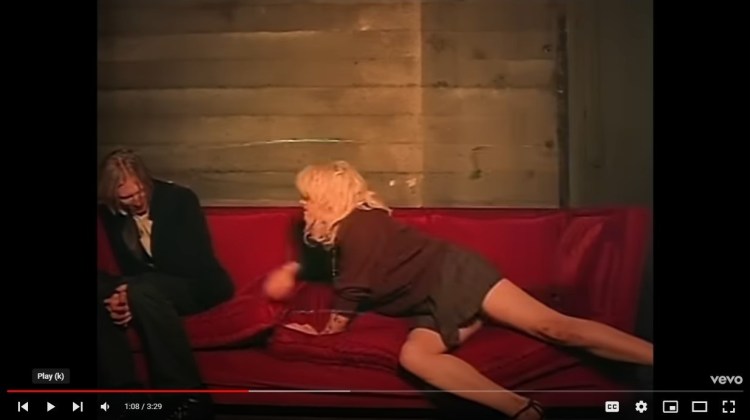
There’s nothing in the “Violet” video as concrete as “Hey, look, that’s from Carrie!” to latch onto. Director Mark Seliger instead piles on one obscure, disturbing image after another, mixing colour with black-and-white and sepia, going in and out of focus, moving from the band playing to the band on a couch to what look like illicit postcards from 100 years ago. Much of the video is given over to a triptych of female strippers, shot like a cross between early silents and underground stag films from the ‘40s. The women, including Love herself,*********** perform for a mosaic of ravenously lecherous lowlifes; there’s an almost subliminal shot at 1:30 of an old geezer gushing “Wow!” that feels like it wandered in from some other video, maybe even some other universe. Maybe the strippers are there simply to acknowledge Love’s own time working clubs as she tried to launch a musical career, maybe they’re a (somewhat pat) metaphor for her new-found fame (“When they get what they want, and they never want it again” overtop an expanse of hands reaching out–later on, “they” becomes “I”), or maybe, generally my preferred against-interpretation way of thinking, everything is intended as pure sensation, there to wash over you–to startle, to confuse, to lodge itself into your subconscious–and nothing more (or less). “Violet” shares with “Miss World” one of the (much-parodied after a while) default settings of grunge, what a thread on Steve Hoffman’s Music Forums website describes as “the repeating structure of muted (or acoustic) verse followed by the shrieking electric guitar power-chord figure chorus”–or, more prosaically, the this-is-the-quiet-part/now-here-comes-the-loud-part dynamic. On “Violet,” the loud parts light out for the stratosphere, as bracing to me as anything to emerge from a female rock voice since the Grace Slick of “White Rabbit.” Harrowing images of Love repeatedly hitting herself in the face feel like they come from a place so private as to be incommunicable. “Mine is forever”; what does that mean? What is it that’s forever?
I had thought about including Imperial Teen’s “You’re One” (1996) as part of this entry, but ultimately its accompanying video amounts to a straight performance clip arted up with split screens and some kaleidoscopic editing effects. I would nominate it as the greatest song ever written about Kurt Cobain–and I’m not at all saying that the two Hole songs could be described as such, although obviously he’s in there somewhere–but I can’t be sure that it even is; there’s the suggestion of some cowardice on Cobain’s part (“We played a show and no one came/We played and played it just the same”), and a declaration that the band–fronted by a gay man, Roddy Bottum–loved him anyway. Two other songs that may or may not have had Cobain in mind: Neil Young’s “Change Your Mind,” released only a couple of months after Cobain’s death, and Filter’s “Hey Man, Nice Shot.” I enthused about the latter’s audaciousness in Radio On, taking it for granted that the title and lines like “I wish I would’ve met you/Now it’s a little late” could only have meant one thing in 1995 (and connecting with, what else, its this-is-the-quiet-part/now-here-comes-the-loud-part dynamic), but the band was adamant that their inspiration was the recent suicide of a Pennsylvanian government employee. The song sounds somewhat generic today, and the video is without distinction.
You’ve probably taken notice by now of what else I haven’t included here: a video by Nirvana themselves. They definitely made a few striking ones, including “Heart-Shaped Box”’s surreal (and surprisingly graphic) womb imagery, and there was also the one set in a school gymnasium, which deserves much more than I can bring to it here–that one needs a book of its own. I’ll finish with a couple of people who did, I think, manage to get at something fundamental about “Smells Like Teen Spirit,” in language as powerfully cryptic and as elusive as the song itself. Greil Marcus, in a short “Real Life Top 10” entry on the video, looked to Shakespeare: “Lear to Gloucester: There’s hell, there’s darkness, there is the sulphurous pit, burning, scalding, stench, corruption.” A few months later, in the spring ‘92 edition of Radio On, Frank Kogan looked to the Strawberry Alarm Clock:
My walk-on guns bring your friends. It’s fun to lose and pretend she’s so whup bowed and self-assured and oh and oh yon dirty word! Halo Halo Halo Harlow, halo halo halo Harlow, halo halo halo Harlow, halo halo halo, when the light’s out, it’s pustageous. Here we are now, entertain us. I feel stupid and contagious. Here we are now, entertain us. I am Blotto and bravado, I’m a scarecrow and a Beatle, yay yay yay. Good sense, inner sense, crypt of mankind. Dead things, many things, I can’t define. I was a wuh, I confess, to fault a skiff and finger-pecs. I met a goo who so fah-spin and always will until the end. Incest and peppermints–meaningless nouns!–turn on your limb! turn your eyes around! And I forget, just why I tasted yeah, yes, makes you smile. I found it hard, it’s hard to find, well, whatever, nevermind. Sha la la. Halo halo halo Harlow, halo halo halo Harlow, halo halo halo Harlow, halo halo halo, when the light’s out, it’s pustageous. Here we are now, entertain us. I am Blotto and bravado, I’m a scarecrow and a Beatle–bloody Nile, bloody Nile, bloody Nile, bloody Nile, bloody Nile, bloody Nile, bloody Nile, bloody Nile, bloody Nile.
That remains my favourite thing ever written about “Smells Like Teen Spirit.”*********** Frank’s stream-of-gibberish lyrics don’t make any more or less sense than Nirvana’s real ones, and I’d be as hard-pressed to explain why I find them so striking, then and now, as I would to explain the pull that Nirvana’s exceedingly strange song had on me, then and now. I used Frank’s review (what that actually was, by the way, a review accompanied by an 8.5 rating ) for that issue’s cover, in conjunction with a photo of Ronnie and Phil Spector in the recording studio. Working from someone else’s script, it felt like, in my own way, I was making a music video.
(Postscript: Since beginning this entry, another list: Paste’s “ 300 Greatest Albums of All Time.” Live Through This, Nevermind, and Daydream Nation are there, the Vaselines and the Strawberry Alarm Clock missed the cut.)
*Is it? I found out via a somewhat vague ILX post, and there’s some commentary (including a couple of people plugging their Substack posts) and an Expert Witness poll on my Facebook wall. In my microscopic corner of the world, maybe. The topic won’t come up at the barbecue my sister is having this afternoon.
**Which essentially means rewriting Rolling Stone’s version of the canon–a project even Rolling Stone participates in nowadays.
***One obvious problem being the staggering amount of music that’s been released since the Gambaccini book; if coming up with a list of 200 albums that, however imperfectly, captured something meaningful about pop-music history was a challenge in 1978, it’s simply folly now. And as far as the ordering goes, my favourite ranking system remains Joe Posnanski’s in his The Baseball 100, where Jackie Robinson is the 42nd-greatest player ever because that’s what number he wore, and Joe DiMaggio is #56 because that’s how many games his celebrated hitting streak lasted.
****Quotation marks because I know I’m falling back on a cliché. Sometimes I’m too lazy and adjective-challenged to come up with anything better.
*****Great video, but even better is Hal Hartley’s “Kool Thing”-backed Godard homage in Simple Men.
************As I did in Happy for a While, my “American Pie” book.
*******From Wikipedia’s “Teen Age Riot” entry: “The song is about an alternate reality where J Mascis is president of the United States.” Which is…close enough, I guess–if I could, I’d go back and unlearn that.
********Something I can now confirm; writing this entry led me to Teenage Superstars, a 2017 documentary on the 1980s pop-music underground in Glasgow, Scotland. The film covers the Pastels, the Vaselines, the Jesus & Mary Chain, the Shop Assistants, and other key bands, and Thurston Moore is a recurring interviewee.
*********Actual rigged election.
**********At least I think it’s a saying, even though I’ve never said it (till now); it turns up a couple of times in Kelly Reichardt’s Showing Up.
***********Love indeed worked as a stripper in the band’s early days, one of the more mundane details from her incredible background.
************When I contacted Frank about using this, he clarified that he was writing only about the song, not the video.
 we don't want to know