“While you are looking, you might as well also listen, linger and think about what you see.” (Jane Jacobs, The Death and Life of Great American Cities)
September 25: It’s Will Smith’s 56th birthday today. In a book where I’ve sometimes overextended myself trying to connect the videos I’m writing about to the news of the day, this bit of serendipity was teed up on a silver platter.* I had a half-day supply-teaching job in a grade 8 class this morning, so I used the opportunity to play DJ Jazzy Jeff & the Fresh Prince’s “Summertime” video for them–which I would have done anyway for the daily “Today in History” thing I always did with my own classes, every day for 20 years–and also to talk a bit about the book you’re reading, the rather amazing coincidence of Smith’s birthday falling on the exact day that I was ready to start writing about “Summertime” for the final entry in something I’ve been working on for 15 months. I asked them, after the video finished, what they thought it was about.** First response: “Party, party, party.” I can’t argue with that. No more hands, so I tried to nudge them with a prompt: “What does the word ‘nostalgia’ mean?” One guy was able to supply a reasonably accurate definition, which surprised me–nostalgia is not generally a big concern among 13- and 14-year-olds.***
I did not, I promise, reserve that final entry for a video whose sole preoccupation is a celebration of nostalgia. As I’ve written before, I’m not anti-nostalgia; I am, in fact, unapologetically very pro-nostalgia. But if that’s all that “Summertime” had to offer–articulated best in the line “And as I think back, makes me wonder how/The smell from a grill could spark up nostalgia”–I might just as well have gone with the Smashing Pumpkins’ “1979,” which, if anything, is nostalgic for something a lot closer to my own life experience than the nostalgia of “Summertime.”
Nostalgia is more like a stepping-off point here; maybe you’ll recognize your own life in “Summertime”’s tour of the neighborhood Will Smith grew up in–or, at least, his memories of that neighborhood through the selective filter of, yes, nostalgia–or maybe your teenage years were strikingly different. But if you take some time with “Summertime” (I’ve never stopped watching it for 30+ years), if you really listen, linger, and think about what you’re seeing, there’s something less ephemeral embedded in there, something more fundamental. I’d be hard-pressed to name another music video that was more meant to be lingered over.**** Community, family, friendship, all of it against the backdrop of a world without cell phones, the internet, or social media. 1990 certainly didn’t feel like any kind of a lost paradise while you were right in the middle of it, but again, “Summertime” doesn’t necessarily feel like 1990. I’m going to risk new depths of wide-eyed rock-critic corniness here by quoting R.E.M. for the third time in this book, but the “Summertime” video is like a road map for life and how to live it. Whatever I said about No in the Introduction, I’m ending on what is, to my eyes, an unimpeachable Yes.
I’ve never read Jane Jacobs’ The Death and Life of Great American Cities. As is sometimes the case–more often than I’d care to admit–I come to someone like Jacobs not through her own writings, but through a documentary I’ve seen, in this case Citizen Jane: Battle for the City, about her decades-long war with Robert Moses, the New York City planner whose ideas about public space and urban development were antithetical to Jacobs’. Moses himself overlaps with another example of what I’m talking about: while I’ve never read The Power Broker, Robert Caro’s massive biography of Moses, one of my favourite documentaries of the past few years was Turn Every Page, which chronicled the working relationship between Caro and his editor Robert Gottlieb as they spent most of their lives trying to finish Caro’s multi-volume biography of Lyndon Johnson.***** Anyway, conceding that what I know of Jacobs’ ideas about how cities should be organized is second-hand, my understanding is that for her, they shouldn’t be. Moses wanted to (to put it mildly) intervene in that organization, with parks and highways and public spaces, everything mapped out according to his whims and biases. Jacobs wanted a more organic city, with neighborhoods and enclaves springing up wherever and however they did, without interference. Community wasn’t something you could engineer; community was a living organism that followed its own path.
I wrote a little bit about community and neighbourhoods earlier, how Wussy’s video for “Halloween” reminded me of a couple of block parties my street held in the first couple of years after we moved from Toronto to Georgetown. Truthfully, it’s not something I felt a lot while growing up; the whole point of living in a small town when you’re young is to get out of there as soon as you can. I did, and after moving back to Toronto for the next three decades-plus, it was a feeling that remained largely absent from my life. One fleeting memory: going out for a walk during the blackout of 2003–I was living on 8th Street, just off Lakeshore Blvd.–and encountering house after house and storefront after storefront where small groups of people had congregated outside on porches or chairs. Cell phones weren’t nearly as ubiquitous then as they are now. People were talking. That felt like community. Since leaving Toronto in 2019, I’ve lived in St. Marys, a small (~7,000 people) town in southwestern Ontario, and I’ve involved myself in about as much around town–sports, local events, volunteer work–as my declining energy level allows. I’ll always have the Albert Brooks Rule to contend with (see Morrissey/Deerhunter entry), but I’m starting to feel part of a community here.
I encountered that feeling in a different way with a couple of publications I’ve been involved in. First, in the mid-‘80s, as part of Toronto’s Nerve, where we had monthly get-togethers after every issue, and where there was the bond of being part of something that was new and different and stood alone in the city. I wrote for Nerve, I helped deliver each month’s issue out of a small van, and three of the many people I met are still among my closest friends 40 years later. That felt like community. Through the ‘90s, something just as meaningful to me: Radio On, a yearly fanzine I put out. Although I eventually met a few of the people who contributed–a mix of Canadians I already knew and Americans who I mostly didn’t–that was a case of mailing out lists of new Top 40 hits and getting back reviews and ratings in the mail (actual mail till the very end, when email came along). The connections didn’t exist in physical space, but that felt like community too. It’s a little bit like the idea that if you think you’re crazy, you’re probably sane; if you live most of your life not feeling part of something, you immediately recognize when you do.
And movies, of course–I recognize that feeling in certain movies. I thought of four right away:****** Frederic Wiseman’s In Jackson Heights, Frank Capra’s It’s a Wonderful Life, Spike Lee’s Crooklyn, and Bill Forsyth’s Local Hero. Everyone knows Bedford Falls from It’s a Wonderful Life, the town George Bailey desperately wants to escape until, in either a drunken dream or a bit of fanciful cinematic license, he learns that he wasn’t just part of a small American town, he was a crucial bit of connective tissue without whom that town would have been radically transformed for the worse (with the implicit message that the same is true of everyone in Bedford Falls: the community as a carefully balanced ecosystem). Local Hero looks at a small village in Scotland from an outsider/interloper’s point of view, as an American oil representative tries to sell the locals on the idea of his company purchasing their village so they can set up a refinery. The American finds himself time and again befuddled by the quirky behaviour and rhythms of the villagers; only when his boss, a transplanted Scotsman from way back, flies over for some last-minute reinforcement are the parties able to find a resolution. A rewatch of Crooklyn, my first since it came out, squared with my general memories of the film: beautiful opening-credits sequence–the Stylistics’ “People Make the World Go Round” overtop a nostalgic tour through an early-‘70s city neighbourhood, with kids jumping rope, playing stickball, and even a bit of Rock ‘Em Sock ‘Em Robots–affectionate memories of Walt Frazier and Soul Train and the Partridge Family, and a great performance by Zelda Harris as the little girl Troy, but also a lot of melodramatic yelling and domestic strife. In Jackson Heights, a documentary snapshot of a maximally diverse Queens neighbourhood in New York City, is very much in line with every other Wiseman film I’ve ever seen: a closely observed x-ray of the day-to-day workings of some institution–a library, a university, a community–and also the meetings and committees and bureaucracy required to keep those institutions up and running. (It surprises me that I love Wiseman’s films so much, being someone who considers any gathering of more than two people generally antithetical to solving anything.) All of these films, and I’m sure many others, are grounded in ideas about community–what binds people together, how all the moving parts contribute to some kind of shared identity. They resonate with me: again, not that they describe my own life, but that I’ve experienced just enough of what I see to feel a twinge of regret for not having experienced more.
I wonder if Will Smith and director Jim Swaffield******* had Spike Lee in mind when they conceived the video for “Summertime.” Maybe one or both of them came out of Lee’s Do the Right Thing a couple of years earlier thinking, “Okay–there’s truth there. But there’s a very different truth that needs to be expressed too.” “Summertime” also appears–as did “People Everyday,” discussed earlier–right on the cusp of Dr. Dre and Snoop Dog’s ascension, a turn by hip-hop (including hit singles that crossed over onto Top 40 charts) towards something harder and, often, more profane. Maybe that was on their radar too. “Summertime” is most definitely not where hip-hop would be within a year or two. But neither, looking back, is it the Fat Boys or Whodini or even DJ Jazzy Jeff & the Fresh Prince’s “Parents Just Don’t Understand” from only three years earlier. It is the end of something, and it stands alone.********
To start, though, a few seconds of “Parents Just Don’t Understand” (or, maybe, of The Fresh Prince of Bel-Air, which had debuted on NBC the previous fall)–just a little something to reintroduce Will Smith the clown, a surreal visual gag that serves as a prologue to the video proper. Smith and Jazzy Jeff are lounging around in a field: cued by Jazzy’s call of “Drums, please!”, they take turns standing up, their bodies split vertically into two distinct film-stock-like frames that overlap imprecisely. They each dance according to character–Smith doing his geeky, life-of-the-party schtick, Jazzy much cooler and in control–and, as if in a Buster Keaton film, half of their bodies walk out of frame, leaving the other half behind. I think it’s the last–the only–pure joke in the entire video, physical or otherwise. I like it; I’m glad it’s there.
Prologue out of the way, the first shot in “Summertime” again evokes Spike Lee: Smith and Jazzy sitting tableside and sipping on cold summer drinks********* (“time to sit back and unwind”), but they’re moving, like on the back of an unseen truck. It’s a variation on a shot that would become, over the course of many films–but already there in Do the Right Thing–Lee’s signature: the camera attached to the actors in such a way that the impression is created of bodies free-floating in space as they proceed down the street. This isn’t quite what Lee does–Smith and Jazzy are shot from the side, just a standard tracking shot, really–but there is that vertiginous feeling, a recognition that they’re unmoored from physical space. (In Crooklyn, a couple of glueheads, one of them played by Lee himself, float down the street upside down, like they’re vampires–apropos.) As they settle back in their chairs, Smith and Jazzy look not at each other but instead do a visual sweep of their surroundings; they want to take in every last detail of wherever the next three minutes will take them. There’s an omniscient calm to Smith in the “Summertime” video that’s not unlike that of Bruno Ganz’s angel in Wings of Desire, Wim Wenders’ highly regarded********** film from a few years earlier. Smith is always a little detached from everything he’s seeing, both participant and observer; in a video that materializes out of the act of remembering, it’s like he wants to make sure he gets everything right for when the day comes where he makes that video.
Here it is, a groove slightly transformed
Just a little something to break the monotony
Of all that hardcore dance that has gotten to be
A little bit out of control
Which is kind of funny, because right before Smith draws a line in the sand with those lines–we’ve got something different here, something you haven’t heard in a while–we get our first glimpse of what he’s remembering: a quick shot of people dancing, the camera gliding down sensuously from above, a block party in full swing. So dancing, yes, but the right kind of dancing: “It’s cool to dance/But what about the groove that soothes, that moves romance/Give me a soft subtle mix…” One of my other favourite songs at the time (I’m somewhat embarrassed to say now) was C&C Music Factory’s “Here We Go (Let’s Rock & Roll).” I’m going to take a wild guess that, for Smith, that was the wrong kind of dancing.
On the “hardcore dance” line, the focus is shifted from Smith and Jazzy to the rich cross-section of people who are the very essence of the video. I’m not sure how to check this in 2024 (or if it even can be checked), but I strongly suspect we’re seeing real-life friends and family, not actors. The mix includes kids, seniors, and young men and women closer to Smith’s age–along with all the dancing that frames everything, they’re seen sitting on fold-out chairs, cruising around town, shooting hoops, and congregating around a barbecue. Smith and Jazzy love these people, and the interaction is physical at times: at 1:15, Smith holds a young boy in his arms, and at 1:40 Jazzy plants a kiss on a woman who I’m guessing is his mom. Among my favourites from an incredible gallery of faces:
- the little girl who reaches out to hug the boy in the baseball cap (0:43)
- the kids at 0:50 who look like they’re in formation for a football play
- the overhead shot of the woman in sunglasses driving (0:54)
- the older guy who flashes the peace symbol (1:04)
- the girl on the swing (1:06)
- the two boys blowing bubbles (1:11)
- the first two guys (one in a “It’s a Black Thing” T-shirt) who lead off the Soul Train line of dancers (2:05)
- the woman in the floral print dress, same sequence (2:15)
- the guy in the grey suit at 2:57 (“as the old folks dance at the family reunion…”)–the video leaves the dancers for a while, then doubles back
The kids and the procession of dancers steal the show (even Smith’s Fresh Prince of Bel-Air three-second turn works). “Summertime”’s obvious homage to Soul Train might have been ahead of Spike Lee on that count (I’d have to check School Daze, which I haven’t seen since it came out); there are two Soul Train nods in Crooklyn (including an extended clip from the show as the end credits roll), and 25 years later, Lee took a three-minute detour in BlacKkKlansman where, cued by Cornelius Brothers & Sister Rose’s “Too Late to Turn Back Now,” a neighborhood bar was suddenly transformed into an ecstatic real-life ST episode. I keep going back to Spike Lee; his influence on hip-hop’s ever-deepening centrality to pop music in the early ‘90s is obvious.
And think of the summers of the past
Adjust the base and let the alpine blast
“Summertime,” not surprisingly, is on my short list of the greatest summer songs ever, with or without video (preferably with). Limiting myself just to songs that actually have “summer” in the title–too overwhelming otherwise: is the Modern Lovers’ “Roadrunner” a summer song?–its only competition at the top would be Sly & the Family Stone’s “Hot Fun in the Summertime” and War’s “Summer,” with Bananarama’s “Cruel Summer” and Mungo Jerry’s “In the Summertime” close behind. (There are readings out there–”out there” meaning on social media–of “In the Summertime” that leave me dumbfounded. I sometimes think Charles Manson, amateur lyrics-sleuth, missed his moment by a few decades.) Possibly the most famous song ever with “summer” in its title (almost certainly the most recorded) is George Gershwin’s “Summertime” from Porgy & Bess. Never cared for it–not Billy Stewart’s hit version, not versions by Sam Cooke or John Coltrane, not the Big Brother & the Holding Company cover found on Cheap Thrills. There’s a political subtext to Gershwin’s song that is open to interpretation, just like there’s a political subtext to Sly’s “Hot Fun in the Summertime”; what may initially appear to be straightforward celebrations of summer clearly have other things on their mind. But Sly’s summer song catches the feeling of summer, the rhythm of summer, even if, as some rock critics have argued of Martha & the Vandellas’ “Dancing in the Street,” it’s in fact a call to action, a manifesto for the Civil Rights Movement (at very different points along the timeline in terms of 1964 vs. 1969, with “hot” fun being a whole different kind of action). Minus that context, though, “Hot Fun in the Summertime” just drifts along, hazy*********** and serene, just as War’s and Will Smith’s summer songs do. Gershwin misses that for me; his summer song sounds lugubrious, almost gothic.
It’s late in the day and I ain’t been on the court yet
Hustle to the mall to get me a short set
Yeah, I got on sneaks but I need a new pair
‘Cause basketball courts in the summer got girls there
The temperature’s about 88
Hop in the water plug just for old times’ sake
Break to ya crib, change your clothes once more
Cause you’re invited to a barbecue that’s starting at four
Ah, politics–that again. I suspect my love for “Summertime” comes across as a little naive, situated as it is somewhere between The Bill Cosby Show (just finishing up an eight-year run) and the full-fledged takeover of gangster rap; its release in May of ‘91 was just a few weeks after the horrific Rodney King beating. I think about how it looks from the vantage point of 2024 next to something like Coolio’s “Fantastic Voyage,” my favourite single of 1994, also a celebration of cruising and girls and barbecues************ but “another kind of trip” altogether as Coolio puts it. To borrow an obvious contrast from one of those community-minded films I mentioned earlier, is “Summertime” Bedford Falls and “Fantastic Voyage” Pottersville?************* When I wrote about “Fantastic Voyage” in Radio On in 1994, I grappled with the song (sincerely but awkwardly) in a way I didn’t need to grapple with “Summertime” just three years earlier–they seemed worlds apart. When I look at the two videos today, I can see more clearly how Coolio’s video for “Fantastic Voyage” is a lot closer in spirit to “Summertime”’s video than to the actual lyrics of “Fantastic Voyage”–it’s literally a dream version of the life Coolio’s wishing for rather than the one he sees, and the one he’s wishing for is more or less “Summertime.” Beyond that, I’d rather just say that each song and each video is true in the eyes of the people who created them (the shorter, friendlier version of the famous Jean Renoir line: “everyone has their reasons”). And, to me, “Summertime” feels very real.
I’m ducking the politics, I know. But politics is not why you remember “Summertime,” and politics doesn’t have much of anything to do with why it’s my favourite video ever. Let me finish with something much more intrinsic to the genius of “Summertime,” a crucial component of music-video history that I haven’t paid nearly enough attention to in this book: the importance of the gesture. A scene from Rosemary’s Baby (1968):
Roman: I remember being struck by a gesture you made, and checking in the program to see who you were.
Guy: Thank you. Um, what gesture was that?
Roman: Well, I’m not sure now. It was a reaction, uh…
Guy: I did a thing with my arms when Luther was having a fit. It was a kind of involuntary reaching.
Roman: That’s it. It had a wonderful authenticity to it
If you were to think about all the videos that have made a lasting impression on you over the years, and if you then started writing down the things you most remember about them, my guess is that your memories would be dominated by split-second moments that are of utterly no consequence at all to whatever story was being told or whatever lyric was being visualized—many would in fact have no connection whatsoever to the song in question. As with Guy Woodhouse’s involuntary reaching that caught Roman Castevet’s attention in Rosemary Baby (or so Roman says; he’s a manipulative Satanist who lies a lot), they would be of an odd hand motion, an intriguing glance, an inexplicable shrugging of the shoulders, an unusual way of sitting on a chair. Some may have been scripted, but I suspect many were quite spontaneous; I don’t think video directors, especially in the early days, would have been quite so controlling as film directors (or as willing to reshoot something that didn’t go exactly as planned). No different than any other kind of acting, on stage or in a film or on TV; actors are always responding and improvising in the moment.************** Going back to the Bangles’ “Going Down to Liverpool,” maybe the one thing you remember from the video four decades later is the way Leonard Nimoy idly drums his one hand on the other hand twice as he tries, yet again, to make sense of his four women passengers. (I’d go for one of the 23 mesmerizing things Susanna Hoffs does.) In “Cheers (Drink to That),” maybe Rihanna tossing her sunglasses out to the audience has stuck in your mind, or maybe it’s the way she dismissively drops her glass after taking her first shot early in the video; in the Beatles’ “Paperback Writer,” Paul does a strange little head feint halfway through that indicates, as if any evidence were needed, the Beatles would have thrived during MTV’s heyday. Madonna, Prince, Missy Elliott–the most successful video artists ever were all masters of the gesture (Michael Jackson, too, obviously, although he was someone who wore out his welcome with me even before the scandals), and you can find such moments in even the most obscure and forgotten videos that live on inside the museum/graveyard of YouTube.
For “Summertime”’s four minutes (exactly), Will Smith*************** is the Picasso and Shakespeare and Willie Mays of gesture. The year he’d already spent on The Fresh Prince of Bel-Air no doubt played a part–Smith didn’t launch his film career until a year later–and he’d of course done a few Jazzy Jeff videos already, but I’m more inclined to view his masterful work on “Summertime” as a musical artist who understood and had lived every last detail of the song he was singing, and who was able to translate that into an ease and spontaneity that required no special training. And through a series of gestures that are both illustrative–they actually do, in this case, mirror “Summertime”’s lyrics–and memorable in and of themselves, he takes a happy song and makes it better.
Gesture #1, 0:38, “All that hardcore dance that has gotten to be a little bit out of control”: Smith holds his hands up and apart in such a way that they look like two alligator clips facing each other. Again, hardcore dance is cool–it’s a little out of control, but not much. The Smiths’ “Panic” this isn’t.
Gesture #2, 0:46, “And if it ain’t broke, then don’t try to fix it”: Or maybe not. Smith calls for a “soft, subtle mix” from days past, something like the Kool & the Gang song he’s sampling. That’s the kind of dance music he wants to hear, the kind that never should have gone away. To underscore the point, he sternly waves–thrusts–his barbecue tongs at us. Everything was just fine, dammit, now pay attention.****************
Gesture #3, 1:58, “And with a pen and pad I composed this rhyme/To hit you and get you equipped for the summertime”: lined up at the grill for some food, Smith lifts his right hand on the word “summertime” and tries to encompass everything around him, the first of two such gestures. More on this below.
Gesture #4, 2:38, “‘Cause you’re invited to a barbeque that’s starting at four”: Smith does a little undulating motion with his right hand, swooping down and then lifting up four fingers — in honour of Public Enemy, he wants to make sure we know what time it is. I just love this moment, and, in connection with a real barbecue, imitated it recently for a friend.
Gesture #5, 3:12, “Fresh from the barber shop or fly from the beauty salon”: Smith pats his hair down, first from the sides, then front to back. He’s young, and he still has remnants of Kid ‘n Play hair, so he can do that.
Gesture #6, 3:22, “Leanin’ to the side but you can’t speed through/Two miles an hour so everybody sees you”: Smith grabs onto an imaginary steering wheel (he and Jazzy are still Spike Lee-ing their way down the street on their invisible vehicle) and leisurely manipulates it back-and-forth a few times–he’s done this a million times and he just wants to let us know what it looks like when done properly.
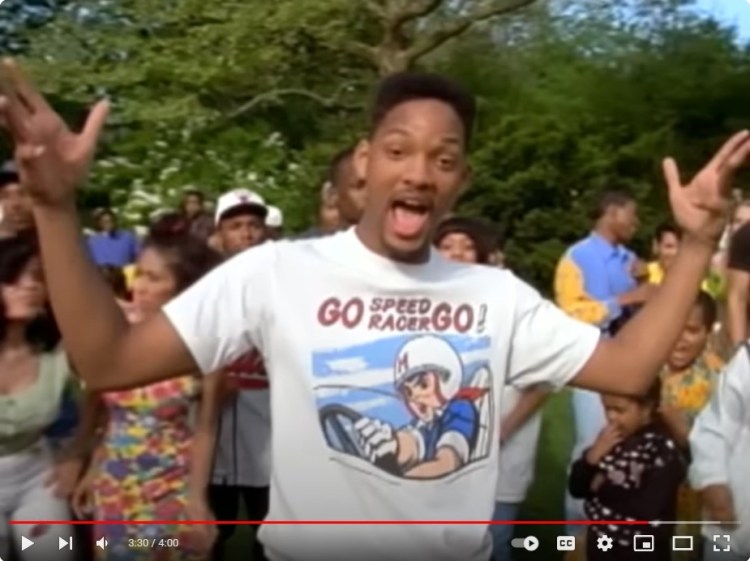
Which brings me to Gesture #7, the grandest gesture of all. More than anything else in any other video I’ve written about thus far, it’s why I wrote this book; I don’t want this one moment to be forgotten. It follows right on the heels of the “two miles an hour” line, and, except for some fadeout repetition of the chorus, it’s the final line of the song:
There’s an air of love and of happiness
And this is the Fresh Prince’s new definition of summer madness
Doubling back to the alligator-clip gesture earlier, the right-handed Smith–I think I can deduce that from watching this video–lifts both arms to eye-level and holds them three or four feet apart on either side of his head. As he lets his arms drop back to his sides, the camera glides past him and he disappears out of frame to the left, the enigmatic trace of a smile the last thing we see. Smith’s outstretched arms are an extension of the earlier “To hit you and get you equipped for the summertime” gesture, with Smith using both arms now instead of just the one. He wants to embrace everything he sees–every person, every sound and every smell, and everything else that can’t even be named or described–sweep it all up into his arms, hold on to it, and, to borrow a line from a not very good movie making the rounds right now, stop time. A common complaint about music videos from the outset (along with the first line of attack, the form’s reliance upon manufactured and ultimately empty images) has been that if a song’s good enough, there’s nothing a video can add to it that the listener’s imagination can’t do a better job of filling in on its own. “A dreamer of pictures,” as Neil Young phrased it in “Cinnamon Girl,” and sure enough, when I used to listen to Neil on headphones in high school–and to Spirit, and to Supertramp, and I think I’ll stop there before I wander too far into my own Dazed & Confused scrapheap–which would have been the exact moment circa 1976 when music videos started to dribble onto niche TV shows, it was entirely up to me to dream those pictures. And that was cool, and seeing as nothing was broke, it wasn’t exactly necessary that someone come along and fix it. But something new came along anyway, and I’m glad. I’ve been flailing around for 5,000 words trying to explain what’s so profound about the “Summertime” video, and I’ve hauled in everyone and everything from Jane Jacobs to Muhammad Ali to Wings of Desire. Music video, I think, when handled with the utmost artistry, made getting to the very essence of a song easier. All Will Smith had to do was lift his arms and smile, and you understood everything.
*I’m intentionally mixing metaphors there as tribute to my late father, who would have celebrated his 90th birthday yesterday. He would say things like that.
**The dreary voice of the teacher–every song and book and movie must be “about” something.
***“Back then I didn’t really know what it was,” Will Smith sings in “Summertime”; Smith turned 23 in 1991–you don’t understand nostalgia until you’re 23.
****Frank Kogan, writing about the Cranberries’ “Linger” in the 1993 Radio On: “This song sure has lingered.”
*****They didn’t; Caro died in 2023, just after the film’s completion.
******I intentionally avoided googling “movies about community,” which would have surely generated a list of 30 or 50 or 100 related films that someone else (or an algorithm) had compiled, and which probably would have encompassed whatever I thought of myself. I wanted to see what I came up with without that; every so often, just for fun, and to see if I remember how, I’ll try to figure something out on my own.
*******I might be making a mistake by leaving DJ Jazzy Jeff out of this equation.
********That’s not true either: originally, I was going to write about “Summertime” in tandem with De La Soul’s “A Roller Skating Jam Named ‘Saturdays,’” which came out almost exactly two months later and, in so many ways, had a video that was “Summertime”’s twin sibling. But I wanted “Summertime” to have the spotlight of the final entry all to itself. Let me note here, though, that together, the two videos stand alone–take that, Yogi Berra.
*********Not gin and juice, I bet, and not those corner-store malt liquors that the characters in Boyz ‘n Tha Hood and Menace II Society favour–lemonade is my guess.
**********By critics; I’ve seen it twice and find it a little tedious.
***********The first summer song to catch my ear as a young kid might well have been Nat King Cole’s “Those Lazy-Hazy-Crazy Days of Summer,” Cole’s last Top 10 hit (not counting revivals of “The Christmas Song”). My parents had an early box set of Cole’s Capitol hits, many of which are ingrained into my earliest memories of pop music.
************And also, it should be mentioned, based on a fondly remembered funk hit from the past: Coolio samples Lakeside’s “Fantastic Voyage” (1980), DJ Jazzy Jeff & the Fresh Prince reach back to Kool & the Gang’s “Summer Madness” (1974). I didn’t know either one as a teenager.
*************In a different context–the path from Reagan’s deceptive, nostalgia-driven “morning in America” to Trump’s unapologetic nihilism–a contrast drawn by Kurt Andersen in Evil Geniuses: The Unmaking of America: “Rather, when we were promised in 1980 the wonderful old-fashioned life of Bedford Falls, we didn’t pay close enough attention to the fine print and possible downsides, and forty years later here we are in Pottersville instead…”
**************Justly celebrated example from the movies: the way Marlon Brando picks up Eva Marie Saint’s white glove in On the Waterfront and tries it on. Another: Jason Robards tapping the desk as he walks away in All the President’s Men after telling Redford and Hoffman to “run that baby” (their latest Watergate story).
***************I assumed, when I started this entry, I would at some point address Smith’s meltdown at the Academy Awards in 2022. I think I’ll take a pass, other than to say that, as publicly aired scandals go in today’s world, Smith’s confrontation with Chris Rock was on the less serious end of the spectrum, more bizarre–like, really bizarre–than anything else.
****************Reminding me, appropriately enough–Smith would go on to play him in a movie a decade later–of Muhammad Ali in his post-Foreman interview inside the dressing room with David Frost in 1974: “Everybody stop talking now–attention.”
 we don't want to know