If I had started writing about Arrested Development and Outkast (see previous entry) three days ago instead of last month, I suspect I would have used “People Everyday”’s proximity to the O.J. Simpson case as a flimsy pretense to work in Simpson’s death on April 10. Rodney King, Sistah Soulja, Anita Hill, Mark Fuhrman–“People Everyday” was squarely in the middle of all that, and, with considerable trepidation, I probably would have jumped in and tried to fumble my way through.
The Presidents of the United States of America’s “Peaches” and Green Day’s “Walking Contradiction” present a much less daunting opportunity to revisit O.J. First off, there’s the simple fact that both were released in 1995,* a year when blanket coverage of Simpson’s criminal trial dominated every corner of the media like nothing I’d ever seen before or, maybe, since (Trump’s stranglehold is comparable). More than that, though, I think both reflected an unmistakable shift in public attitude towards the O.J. saga and the attendant media coverage. First as tragedy, then as farce; O.J. was one thing in 1994 and another thing in 1995, and these two videos take me back to the second half of that story like it was yesterday.** (There’s also a far more tangible link between the two that you may have picked up on immediately; I didn’t clue into that connection until I got halfway through this entry, so I’ll revisit that later–it would be misleading to suggest that that had something to do with pairing them together.)
When the Presidents of the United States of America’s debut album came out on March 10, 1995, the Simpson trial was into its seventh week. There was, as I remember it, still a fundamental solemnity hanging over the proceedings, heightened considerably when Mark Fuhrman took the stand for the first time three days later. But–slowly at first, and then the floodgates opened–the grim reality of what actually happened (domestic abuse, double murder) started to fade and the circus-like atmosphere of the trial became the new national obsession. A Scott Harris piece in the L.A. Times dated April 13, 1995 is an instructive look at the ground shifting underneath:
In comedy, timing is critical. It’s interesting that “The Tonight Show”’s spectacular surge in the ratings began after a spectacular double homicide in Brentwood–not that there’s anything funny about murder, and not that just anyone can pull off this type of humor…“We’ve never mentioned Nicole Brown. We’ve never mentioned Ron Goldman. We’ve barely mentioned murder,” (Leno) explains. “You will say, ‘at the crime scene,’ or ‘the night the crime happened.’” The M-word makes an audience uncomfortable.
On March 21, eight days after Fuhrman’s testimony, Kato Kaelin took the witness stand for the second time. And that’s what “Peaches” and “Walking Contradiction” are: the Kato Kaelin/Dancing Itos/Jackie Chiles*** face of the trial, the perfect backdrop for a new kind of endlessly absurd media spectacle that had evolved from no jokes to nothing but within the space of a year.
I’m happy to say that both songs were on my year-end Eye Weekly**** ballot for 1996, “Peaches” at #1 (“the dumbest song I’ve voted #1 since the poll started”) and “Walking Contradiction” #4; I also had “Walking Contradiction” on my list of 10 favourite videos, which consisted of only three actual videos (Beck’s “Devil’s Haircut” and the Smashing Pumpkins’ “1979” the other two) and lots of movie- and TV-related clips. I didn’t mention O.J. in either of the two little blurbs I submitted, opting instead for the Brady Bunch, the Stranglers, and (unnamed) bosses I used to work for at dead-end jobs. I don’t really think “Peaches” is dumb, by the way, probably not then and definitely not now–that’s a defense mechanism I sometimes preemptively trot out. Today, especially when I watch the video, I think it’s insanely funny and–O.J. again–the bubble-grunge equivalent of the Dancing Itos, but so much better.
Right from its opening shot, a high overhead track that glides past a tree (cans? are those aluminum cans hanging from the branches?) and rests on the band below, nothing really makes sense. The guitarist is plucking away at his instrument, which is draped across his lap, and we hear a tremulous, country-slide kind of riff, something you might expect to find on an old Allman Brothers or John Fahey album, not from the indie band that had recently crossed over onto pop charts with the novelty hits “Kitty” and “Lump” (which were, respectively, annoying and catchy to my ears, but if there are certain bands to which “annoyingly catchy” might cover everything they ever did, the Presidents were one of them). His playing is reverential almost, emerging from some idyllic hideaway deep in the wilderness. Maybe we’re in the Garden of Eden itself. Maybe we’re in the Garden of Eden itself.
Movin’ to the country
Gonna eat a lot of peaches
I’m movin’ to the country
I’m gonna eat me a lot of peaches
The simple life, as Paris Hilton and Nicole Richie would call it a few years later. And it’s all there for the taking–those aluminum cans overhead (okay, so that’s it, they’re tinned peaches), a full box of peaches on the ground, bountiful nature in all directions. Chris Ballew, the singer–looking a little like Carel Struycken’s Giant in Twin Peaks–is so overcome with joy, he does a little impromptu dance at the one-minute mark, drumming away with his hands as his body sways back and forth. (This, even though we’re told that, far from being a wellspring of everything healthy and natural, the perfect elixir, peaches in fact come from a can, put there by some guy in a factory downtown–the Presidents seem okay with that.) Ballew and guitarist Dave Dederer arch their eyes heavenward, fixated on either God or all that low-hanging fruit, and at 1:25, for no discernible reason, Ballew pulls out his most dramatic rock and roll move yet, scrunching up his face and pointing right at the camera on the line “and dreamed about you, woman.”*****
A few seconds later, trouble in paradise: Ballew taps drummer Jason Finn on the shoulder and directs his attention rightward, where we see an indefinable shape dart through the foliage. More darting shapes, confusion all around, and a stark tempo shift into a classic descending guitar riff like the one in Chicago’s “25 or 6 to 4,” punctuated by random yelping–sounds like “yah-yah”–from Ballew. The band keeps looking up, they slowly creep forward, stuff continues to happen in the shadows, the camera wobbles and circles around overhead, and then, at 2:08–“LOOKOUT!!!”–all hell breaks loose. A trio of ninjas materializes from above, maybe on a mission to steal all those scrumptious fake peaches, possibly just rogue ninjas out for a good time. But those same Presidents who were looking so unnerved only seconds ago take up a resolute defensive stance; like the shot of adrenaline that allows humans to lift cars in moments of extreme duress, they’ve suddenly tapped into their own inner ninjas.
The ensuing battle is ferocious, swift, and expertly choreographed. The highlight is Ballew kick-thrusting himself off the ground and onto the shoulders of one of the ninjas, from where he pushes off again and sticks the landing on one of those high overhead branches. Bodies soar through the air balletically, Finn sends a ninja backpedalling right into a tree, and when all appears lost–Dederer flat on the ground and getting pummelled–Ballew and Finn jump down from above and save the day. At no time, it’s worth mentioning, does anyone attempt to use a peach, either in canned form or one of the loose ones from the box, as a projectile. Just as with the Geneva Code and the Marquis of Queensbury, guerilla ninja warfare has its rules.
The inspiration for the “Peaches” video may have been the Teenage Mutant Ninja Turtles, the comic-book creation that hit a new level of visibility across the culture a few years earlier with the launch of a lucrative film franchise. Or maybe the Presidents were just fans of martial-arts films in general, I don’t know. “Peaches” was actually right on the cusp of the genre crossing over from cult-leaning genre cinema to art-house fare: Crouching Tiger, Hidden Dragon (2000), Hero (2002), and House of Flying Daggers (2004) all won numerous awards and placed on year-end critics’ lists. (Throw in Quentin Tarantino’s two Kill Bill films, 2003 and 2004, if you want, maybe even 1999’s The Matrix.) So put “Peaches” somewhere on that timeline, when filmed martial arts turned its attention away from cartoon superheroes and moved into the realm of prestigious Academy Award fare (“Peaches” occupying space much closer to the one than the other…). That’ll allow me to sidestep what else a mid-‘90s video about villainous men jumping out from the shadows might really have had on its mind.
I won’t hide behind the same dodge with Green Day’s video for “Walking Contradiction,” in which the band appears as three blithering idiots walking around town obliviously as everything around them is destroyed. When I wrote about the video in Radio On at the time, I drew a comparison to Nick Carraway’s observation in The Great Gatsby that people like Tom and Daisy Buchanan “smashed up things and creatures and then retreated back into their money or their vast carelessness, or whatever it was that kept them together, and let other people clean up the mess they had made.” And I think that’s true–but instead of Tom and Daisy, let me recast the three Green Days here as Kato Kaelin in triplicate, the most purely comic character in the O.J. universe, perhaps the one bit player you could laugh at and make jokes about without first having to stipulate the fundamental tragedy of the story. Did Kato leave messes for others to clean up? Not surprisingly, he started popping up on TV after Simpson’s death, telling a rather different story than he did on the witness stand in 1995; I saw one lawyer point out that if Kaelin had been as forthcoming 30 years ago, Simpson might well have been convicted.
“Walking Contradiction” is my pick for the apex of visual overload in music video.****** The amount of stuff it manages to cram into four minutes is remarkable. There have been many videos produced both before and after with bigger budgets–“Walking Contradiction” doesn’t appear anywhere in Wikipedia’s list of the 100-plus most expensive videos ever made–but in terms of non-stop kinetic density, I don’t think it’s ever been equaled. Which is a good time to mention that other thing that links it to the “Peaches” video: both were directed by Roman Coppola, son of Francis Ford and brother of Sofia. I knew that Coppola directed “Walking Contradiction” and mentioned him in the Radio On review, but discovering just now as I write this that he was also behind “Peaches” is a revelation. (He also directed the Presidents’ “Lump” video.) Thinking about all those whispered conversations in darkened rooms in the two Godfathers, about the inscrutable interiority of Gene Hackman’s Harry Caul in The Conversation, I wonder if Roman approached his video work with the guiding thought that “Pop’s way of doing things is over–even he knows that.”*******
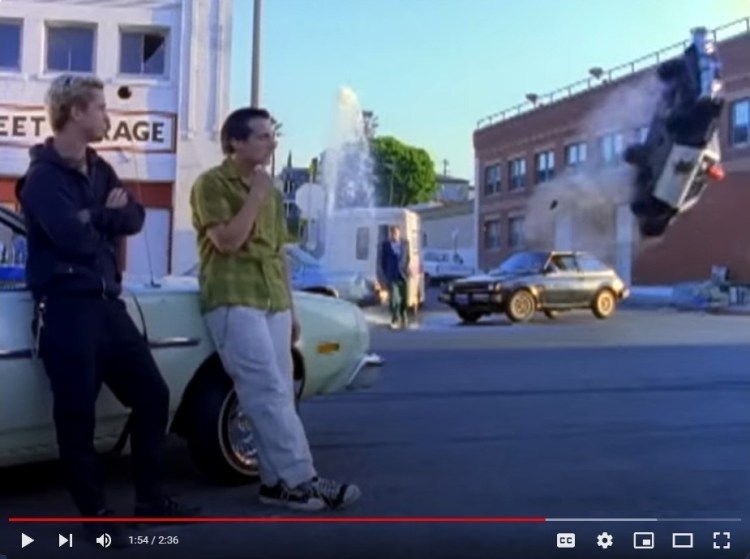
“Walking Contradiction” begins with Billie Joe Armstrong briskly strolling along in some storybook neighbourhood right out of the Monkees’ “Pleasant Valley Sunday,” complete with finely manicured lawns and a white picket fence like the one at the beginning of Blue Velvet. He idly tosses a stick away eighteen seconds in, enough to send an approaching cyclist crashing to the ground, which is immediately punctuated by a car running over the poor guy’s bike. Billie Joe sees none of this; most of the video’s mounting litany of disasters occur unbeknownst to the band, and even when they are aware of what’s happening around them, they register no reaction. Next up, Tré Cool dislodges a bread truck getting a tire changed, which in turn leads to other vehicles getting damaged and a minor collision. A yawning Mike Dirnt waves to an overhead city worker fixing a traffic light; he presses the signal button–cut to a close-up of his hand, a handwritten “Out of order–do not use!” sign posted right above the button–and the resulting mini-explosion sends the city worker hurtling to the ground.
The trail of destruction gets exponentially more spectacular: another collision, this one multi-vehicle, with cars colliding into each other one after another such that Billie Joe is able to continue his morning jaunt undisturbed, protected by an invisible force field around him; a hoisted piano falling to the ground******** (reflected light from Billie Joe’s mirror temporarily blinds the man doing the hoisting); a fire hydrant dislodged by the aforementioned bread truck, a jetstream of water spouting skyward; and, as our three Katos converge on a bench, the most visually daring bit of mayhem yet, a police cruiser sent airborne and held there for almost 15 seconds, twisting and turning through space, broken up by my single favourite shot in the whole video, a blurry close-up of Tré Cool at 1:55. What are we to make of him impassively staring at the suspended cruiser but really looking directly at us?
Beg to differ, on the contrary
Agree with every word that you say
Not much help there. The Green Days jump in their car and beat a retreat, presumably to wreak their peculiar brand of havoc on some other unsuspecting corner of the city, but a final farewell: the demolition of a 14-story building as they drive away, the video’s one bit of carnage that seems to be unrelated to Billie Joe, Tré, and Mike (or maybe I’m just not looking carefully enough). Impressive building. Blowed up real good.
Are Kris Kristofferson (“He’s a walkin’ contradiction, partly truth and partly fiction” from 1971’s “The Pilgrim, Chapter 33”) and/or Travis Bickle (in Taxi Driver, Betsy quotes those same lyrics back to Travis as she tries to verbalize his weirdness) lurking somewhere here? I think I’ll stick with O.J.–I can only juggle so many specious connections at once. “Walking Contradiction” and “Peaches” are a perfect snapshot of the post-O.J., everything’s-a-joke mindset that seemed to take over the culture in the latter half of the ‘90s (till 9/11 set the clock back to zero again for a time), a kind of omnipresent punchline that took in Harvey Danger’s brilliant “Flagpole Sitta” (so-so video), the slacker in the “Homerpalooza” Simpsons episode who declared “I don’t even know anymore” when asked if he was being ironic (airdate of May 19, 1996), and Monica Lewinsky’s blue dress. “Too soon” people like to say when someone crosses what I’ll dub the Alan Alda Line, after Alda’s formulation in Crimes and Misdemeanors that “comedy is tragedy plus time.”********* The question of how much time might be measured in years, or maybe even decades; with O.J., the gravity of the murders and the abuse seemed to give way to pure spectacle in a matter of months. These two videos capture that accelerated transformation in a way that still resonates almost three decades later.
*On their respective albums, that is; neither was released as a single until 1996. The machinery of churning out hit singles was still relatively new to bands like these.
**For me, the best representation of how intensely serious a story the Simpson saga was early on also appeared in 1995: the opening scene of “Roseanne’s Return,” the first episode of The Larry Sanders Show’s fourth season. Larry and his staff are gathered around a television set watching the trial in Larry’s office, everyone staring intently at the screen and no one uttering a word. Being a sitcom with a production schedule of its own, the Sanders show was lagging there, tapping into a mood that was a return to a year earlier, when news of the murders first broke. No jokes.
***The Johnnie Cochran stand-in on Seinfeld: “That’s totally inappropriate. It’s lewd, lascivious, salacious, outrageous.”
****A free weekly based in Toronto.
*****A little research reveals that “Peaches” was in fact about a woman Bellew was pursuing, so maybe she was the intended recipient here. I think I like his arena posturing better as a completely random gesture.
******Perhaps joined by the Beastie Boys’ video for “Sabotage” three years earlier. That I choose to write about the one but not the other essentially comes down to one simple distinction: I much prefer “Walking Contradiction” as a song.
*******CQ, Coppola’s debut feature film, would be released in 2001. I don’t remember much–Paris, late ‘60s, Barbarella–and from there he went on to collaborate with Wes Anderson on a number of films, which I’ve decided is not a serious enough crime to banish him from this blog.
********R.E.M.’s “The Great Beyond”: “Over my shoulder a piano falls/Crashing to the ground”–something to do with Andy Kaufman, I’m sure, but you’d swear they had the “Walking Contradiction” video in mind.
*********Attribution of which seems to be in some dispute; a site called Quote Investigator credits Steve Allen with originating the line in a 1957 Cosmopolitan piece on comedy.

