I don’t really have anything that links these three videos beyond the obvious–female artists, British, mid-‘80s–but I do have a starting point: Taylor Swift. If you write about the solar system, you’re going to have to bring up the sun at some point. As I sit down to write this morning, Swift occupies spots #1 through #14 on Billboard’s weekly Hot 100 Singles chart; then there are songs from some of the other people who are out there making music, then more Taylor Swift, then the other people, then more Taylor Swift. Thirty-two entries in all from Swift–the entirety of The Tortured Poets Department, her new album, plus a holdover #1 from last year. The holdover is “Cruel Summer.” So that’s where I’ll start.
In what will surely be a Taylor Swift song title one day, it’s déjà vu all over again. I took a similar detour in a book I published last year about Don McLean’s “American Pie,” which was ceremoniously eclipsed by Swift’s “All Too Well” on that same Billboard Hot 100 chart as the lengthiest #1 single ever (over 10 minutes long). I tried to make sense of Swift’s 2023 version of chart dominance; I couldn’t. The 2024 version, no progress.* But I have moved the needle a bit when it comes to my familiarity with her music, courtesy a thrift-shop copy of 2012’s Red. I liked “Girl at Home” enough to save on my hard drive. The rest went right past me. “Cruel Summer,” 2023’s holdover #1 (currently #41, one week shy of a full year on the Top 100) did not go right past me. “‘Cruel Summer’–really? That title’s taken, I think.”
Neil Young and Yo La Tengo are a couple of artists who attach famous titles to new songs of their own with some frequency: Neil’s had “Born to Run,” “Goin’ Back,” “Sail Away,” and “Little Wing”; “We’re an American Band,” “Everyday,” “I’ll Be Around,” and There’s a Riot Goin’ On (album title) for Yo La Tengo.** Hard to say whether such a ploy speaks more to arrogance or foolishness, or if it’s simply a case of paying tribute. Or perhaps a little bit of all three. With something like “We’re an American Band,” I’m guessing the title is meant as more of a joke than anything else: “What should we call this dreamy mood piece? Uh, how about ‘We’re an American Band’?”
Nor do I know which of those explanations apply to the idea of resurrecting the title “Cruel Summer” (especially with three songwriters involved–Swift, St. Vincent, and Jack Antonoff–who may each have had entirely different motivations) some four decades after Bananarama’s song of the same name, their first Top 10 hit in North America. Quite a mismatch for me as to which “Cruel Summer”’s better, but, as you may have sensed, I’m not the world’s biggest Taylor Swift fan.
Far away; “Cruel Summer” Sr. is one of those videos–I’ve covered a few so far–that give me an overwhelming feeling of far-awayness. Which is interchangeable to a degree with nostalgia, but there’s an undercurrent of sadness that makes it qualitatively different than the kind of nostalgia I feel when I hear, say, “Build Me Up Buttercup” or “Love Grows (Where My Rosemary Goes),” both of which exist at the blissful end of the nostalgia spectrum. A lot of that is rooted in the song itself, of course–how could something called “Cruel Summer” not involve sadness? (getting back to Taylor Swift…no, I’ve said enough already)–some belongs more to the video, and then there’s also how they both fit into my own timeline. In any event, I love that feeling. Paradoxically, it feels closer and closer–more immediate–the older I get. It’s a nice place to lose yourself. The Drifters went up on the roof, Brian Wilson retreated to his room, I like to look at old music videos.
I’m not sure if I’d already bought Bananarama’s first album or not when “Cruel Summer” turned up on the radio in the summer of ‘83. I would have, at the very least, known “Really Saying Something,” their Motown (Velvelettes) cover that got some play on The New Music, but maybe not “What a Shambles,” the song that ended up being my favourite from their debut.***
I wish you were in our shoes
I wish you could be us
Washing all your laundry
And riding on the bus
Bittersweet words of resignation that also capture the mood of “Cruel Summer,” which begins with the three women of Bananarama–Sara Dallin, Siobhan Fahey, and Keren Woodward–wearing dungarees and working on their clunker-of-a-car’s engine, intercut with shots of them ambling, skip-hopping, and voguing around the streets of New York. An undercurrent of us-against-the-world is established from the very first shot; on the line “Strange voices are saying,” they pass two men who eye them curiously, but the trio pays them little mind (just a quick backwards glance from Woodward) and proceeds up a tenement staircase. There’s a recurring shot of them sitting high up on a rooftop ledge as they sway and gesture along to the music. Ambling, swaying, and New York City in the summer–that accounts for most of the video, along with the introduction, around the one-minute mark, of a mysterious Mack truck, followed by the equally mysterious development that the band is being pursued by the police. (One of the detectives incongruously but unmistakably evokes Boss Hogg from The Dukes of Hazzard.) Bananarama hop into the Mack truck, defiantly waving and tossing out banana peels as they pull away. It all ends back on the rooftop, and this time the band is–absurdly, and inevitably, and wonderfully–joined by the two cops and a bunch of other people as they dance the night away, with the majestic Empire State Building looming prominently in the background. Hard not to think of Warhol.
Sara Dallin in a recent interview with People magazine (prompted by the fact she hadn’t heard the other “Cruel Summer” yet!):
It was about our friends because we just sort of made it quite big at that point. We were on Top of the Pops, and so we’re doing loads and loads of promo. We were used to going on our little annual holiday and then we couldn’t go because we had so much promo. We were just moaning because all our friends were going on holiday and we couldn’t, and the city is very oppressive in the heat in London and New York or wherever. So that was the kind of inspiration for it.
So it’s all for show, the dancing and camaraderie and adventure–they’re alone and missing their friends, exactly like the song says. As for “we just sort of made it quite big at that point,” okay, but they’re about to become much bigger, and then, when their cover of “Venus” hits #1 on Billboard three years later, bigger still. “Cruel Summer” to me feels very much like Rod Stewart singing about Madame Onassis on “You Wear It Well”: they’re still on the other side of the fence peering in, still washing all their laundry and riding on the bus. Poignant.****
Daydreaming away the quiet desperation of everyday life***** is also the subject of Tracey Ullman’s video for “They Don’t Know,” her surprising Kirsty MacColl cover released just a few weeks after “Cruel Summer.” Surprising because it became a Top 10 hit on both sides of the Atlantic–the song disappeared quickly when MacColl wrote and recorded it in 1979–and even more surprising because Ullman, a TV comedienne, wasn’t even a singer until Stiff Records approached her about doing an album. The TV-to-pop-star makeover is a time-honoured tradition that takes in Ricky Nelson, Patty Duke, Bobby Sherman, John Travolta, and many others; the depth of their musical background and the quality of their recorded output varies widely (Nelson is deservedly in the Rock and Roll Hall of Fame), so no pejorative intended.
“They Don’t Know” was already a British hit (“Karma Chameleon” kept it out of the #1 spot) when Ullman spent a week as a guest VJ on MTV in February of 1984. Not sure how they finessed any conflict-of-interest issues there–radio was a big payola cesspool then anyway, according to Fredric Dannen’s Hit Men, and there’s no reason to believe that didn’t extend into MTV, either directly or as a two-way street–but one way or another, “They Don’t Know” soon landed in the Top 10 on Billboard, too. We’re back where this blog started, 1984, which was to music-video what 1967 was to San Francisco and 1939 was to Hollywood. That “They Don’t Know” was suddenly up against the likes of Michael Jackson,****** Van Halen, the Police, Phil Collins, and Huey Lewis–not to mention such newly arrived Godzillas as Madonna, Duran Duran, and Culture Club–when it entered the Top 100 on Feb. 25 just adds to its underdog scrappiness and makes me love it that much more.
“They Don’t Know”’s video gives us three Tracey Ullmans, not one, a timeline that takes us from childhood to present-day, with most of the clip set maybe 10 years ago. We see Tracey as a kid in brief snippets of old home-movie footage (it looks as if it really is her), as a resigned and decidedly unglamorous housewife in the here and now, and as the lovestruck young woman who, at some unspecified point in time, entered into the relationship over which she now finds herself ruminating. MacColl’s song, heard on its own, is testament to a lifelong devotion that’s all the more touching for its clear-eyed pragmatism (something like Charlie Rich’s “Life’s Little Ups and Downs”):
Got my eyes wide open and I see the signs
‘Cause they don’t know about us
And they’ve never heard of love
Ullman’s video is a bit of a different story.
In the young-woman scenes that take up more than half the clip, Ullman and her beau exude a kind of cartoonish glamour. We begin with Ullman, wearing a pink sparkly lamé blouse and hoop earrings, applying lipstick as she looks into the mirror; her boyfriend Paul (they drive around with a “Paul and Tracey” banner draped across their front windshield), also in a lamé jacket, looks like he’s right out of MacColl’s “There’s a Guy Works Down the Chip Shop Swears He’s Elvis,” her first hit from a couple of years earlier.******* They’re out for an evening of that most glamorous of all sports, bowling. At the 45-second mark, the first hint that all may not be as it seems: Paul throws a gutter ball and Ullman turns to the camera (and us) with a look of “Can you believe this idiot?” exasperation. After Ullman takes her turn–a strike, it looks like–a bizarrely sexualized image at 1:10 that has Ullman almost straddling the ball rack as her bowling ball rolls over some wieners and through her legs. That’s right–wieners.
The home-movie footage turns up after that–first Ullman as a toddler, then as a young girl–followed by a dimly lit chorus line of ‘70s-era females cross-stepping in unison (lots of platform footwear visible) and ending on Ullman alone in her room, decked out in Rollermania gear (and with a poster of Gary Glitter visible over her left shoulder that I’m sure the video’s makers would be happy to excise today). A quick recap follows–chorus line, Ullman, home-movies–and then, on the song’s climactic “Ba-by!”, we cut to Ullman pushing a shopping cart down a supermarket aisle. At least a decade has passed; her hair is dishevelled, she’s wearing a ratty old sweater and–a comical echo of her glammed-up past–poofy pink slippers, and we see a young child sitting in the cart. As she absentmindedly tosses items into her cart (but taking a second to check the price on a box of a cereal), the lyrics tell us one thing–“There’s no need for living in the past”–while her facial expressions and hand gestures tell us something altogether different: worded in the form of a question, as they say on Jeopardy, something closer to “Well, how did I get here?” Just as she gets to the “got my eyes wide open line,” the final humiliation: it’s old thinks-he’s-Elvis Tony, working at the supermarket and shelving items. He gives Ullman a highly inappropriate pinch as she passes; it’s 1984, so she just rolls her eyes and moves on, waving him out of her life with one last withering “They’ve never heard of love.”********
But wait–there’s a coda, one of the most miraculous half-minutes in music-video history. We cut back to the Paul-and-Tracey lovemobile, ten years having instantly melted away–same hair, dress, and earrings on Ullman–but with a major change: sitting there at the wheel is a totally different guy, and this one thinks he’s Paul McCartney. Because, well, he is.
I might be wrong about this, but my recollection is that the years between John Lennon’s murder and the surprisingly okay Travelling Wilburys were not good ones for the three surviving Beatles (or for fans). They did not, going it alone, seem especially suited to the video takeover of pop music. (I guess you could argue that George was at home.) Paul, oddly enough, was on the same Billboard Top 100 where “They Don’t Know” debuted, and not once but twice: the aforementioned “Say Say Say” alongside Michael Jackson, and also on his own with “So Bad.” On the chart he feels like–and on the radio, I bet, he sounded like (don’t remember)–a ghost. Next to Ullman, he’s the Paul of her dreams, the one who makes it right, the they-don’t-know that we didn’t know about till now. He’s Beatle Paul. And he’s alive.
Tracey just knew that something good was gonna happen, she just didn’t know when. “Cruel Summer” and “They Don’t Know” make for a natural pairing–two versions of girl-groupdom in the video age (neither with the commercial clout of MTV’s two biggest modern-day girl groups, the Go-Go’s and the Bangles)–but Kate Bush was about as girl-group as Yoko Ono, and “Cloudbusting” didn’t come along until a good two years later. But all three share strong ties to the movies. The American pop audience’s exposure to “Cruel Summer” owed as much to its appearance in The Karate Kid–whose release date of June 22, 1984, perfectly set up the song’s U.S. release two weeks later–as to its video, while “They Don’t Know” was used over the opening credits of Our Nixon********* three decades later. The “Cloudbusting” video has film connections everywhere, both then and more recently. Appearing alongside Bush, Donald Sutherland,********** who unlike cult-hero Leonard Nimoy from the Bangles’ “Going Down to Liverpool” was a legitimate first-tier movie star (making the transition to supporting roles in 1985), with a career’s worth of awards and accolades to his name. Monty Python’s Terry Gilliam worked with Bush on the original idea of turning the song into a short film. And when it was reconceptualized as a music video, the job of directing was handed to a longtime Python collaborator, Julian Doyle. That’s a lot of cinematic DNA, and it shows: “Cloudbusting” is the kind of wildly ambitious, heavily scripted, and highly stylized video that turned up regularly in 1985, an expensive shortcut to getting your song noticed and onto MTV. Many of them, the white elephants (to borrow Manny Farber’s immortal phrase) of the music-video explosion, have not dated well. Not true of “Cloudbusting,” though–it’s a true epic, a Werner Herzog-scaled tribute to a visionary madman who wanted to play God.
Sutherland portrays Wilhelm Reich, the radical psychiatrist and inventor–the “orgasmatron” in Woody Allen’s Sleeper is a parody of Reich’s “orgone accumulator”–who later in his life designed an aluminum contraption called a cloudbuster that could summon forth rain from the atmosphere on command. (If you’ve seen the film Twister, Bill Pullman and Helen Hunt’s tornado-detector “Dorothy” gives you a rough idea of what Wilhelm’s cloudbuster looked like.) Bush appears as his son Peter (with appropriately shorn hair), whose A Book of Dreams (1973) served as the inspiration for “Cloudbusting.” I haven’t read the book, but as presented in the video, Bush/Peter is Wilhelm’s dutiful assistant, pushing (to the point of exhaustion) the cloudbusting apparatus up a steep country hill. The father and son have a loving, playful relationship, and the on-location photography, all rolling vistas and mist-shrouded background, is stunning. Wilhelm unveils his cloudbuster, they aim it heavenward, and, far below in the distance, Peter spots a car. Rolling, majestic clouds congregate en masse, but no rain. Wilhelm retreats to his workshop, and, after rejecting an idea or two, he seems to have a flash of awareness as his smiling son joins him (a vision?) and hands over a crude drawing. Cut to a group of shadowy men assembling, then back to Peter (still on the hill, so yes, a vision) again spotting the car in the distance as the men break into Wilhelm’s workshop, arrest him, and destroy all his work. Peter makes his way down the hill just in time to see his father being taken away in a car, gesturing to him through the back window. Peter now knows what to do; he knows exactly how to make it happen.
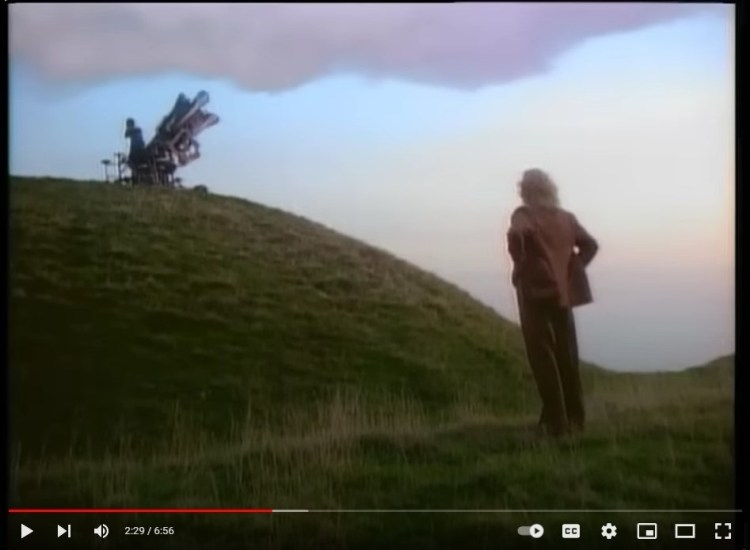
The video’s final minute is cathartic and near mystical. Peter returns to the top of the hill, and this time the cloudbuster produces rain. We see Wilhelm smile inside the car as rain splashes against the back windshield, the rain-streaked camera blurring everything, and, nearing six minutes now, it all culminates in a final image for the ages: a long shot of Peter and the cloudbuster perched on the hill,*********** silhouetted against a foreboding, dark-purplish sky that gradually gives way to some blue at the last second. The sun’s coming out.
To my ears and eyes, the “Cloudbusting” video sits right at the midway point–the sweet spot–between happy and sad. Wilhelm is gone, but his fevered dreams survive (with Dave Lawson’s dramatic string arrangement scaffolding the mood the whole way). Same with the “Cruel Summer” and “They Don’t Know” clips. The sweet spot: your friends are gone for the summer, but adventure and new friends await; the initial swoon of romance fades, but memories (real and imagined) remain. I sometimes think all my very favourite art, whether songs or movies or novels, occupy the same space, and, if needed, I supply the missing sadness or happiness myself. As soon as something tilts too far in one direction, more becomes less.
*Trying to dig up something from one of Bill James’s Baseball Abstracts is near impossible: there are 12 of them, and none are indexed. But I remember he wrote something once about a minor league player–I think either Joe Bauman (who hit 72 HR in 1954) or Steve Dalkowski (who was striking out two batters per inning in the late ‘50s, when that was unheard of)–where the player had done something so unprecedented, so off-the-charts, that major league teams found it easier to discount what he’d done altogether than to give the player a fair shot.
**Scott Woods has pointed out to me that Lana Del Rey (I have a couple of CDs but don’t know her discography that well) also does this often: “Cinnamon Girl,” “Lust for Life,” “Heroin,” and other titles either exact or very close.
***Still my favourite Bananarama song, but the only video I can find is a very strange homemade clip from 2008 consisting of an out-of-focus cityscape at night, some random zooming in and out, a close-up of a disco ball that feels like you’re inside the aurora borealis, and a brilliant wash of coloured bulbs. If Stan Brakhage hadn’t died five years earlier, I might wonder if it was his invisible hand at work. Tempting–but the “Cruel Summer” clip is good enough that I’ll stick with that.
****Sometimes it’s good to fill yourself in on the background details, sometimes you’re better off not knowing. From Wikipedia: “After an exhausting morning shooting in the city in brutal August heat, the band returned to the tavern for lunch. They made the acquaintance of some local dockworkers, who, upon learning of their situation, shared vials of cocaine with them. ‘That was our lunch,’ said Fahey, who had never tried the drug before.” So it wasn’t just tears-of-a-clown sublimation behind all that dancing.
*****One of the greatest pop-song subjects of all; if I started listing examples, I’d still be at it six hours from now.
******Duetting with Paul McCartney on “Say Say Say”–more on Paul momentarily.
*******“Maybe my least favorite song-about-Elvis” Greil Marcus recently wrote on his Substack blog–surprising.
********There’s an intriguing ambiguity, I think, as to where Ullman and Tony stand in relation to each other at this point in time: maybe they’re married and the child is his, maybe only the child remains from a relationship that ended years ago, maybe he’s just a footnote from the distant past.
*********Penny Lane’s 2013 documentary assembled out of super-8 footage filmed by H.R. Haldeman and Dwight Chapin. In You Should’ve Heard Just What I Seen, I wrote about Lane’s appropriation of the Ullman song as a remarkably intuitive expression of unknowable love between a worshipful staff and their corrupt boss. (“Cloudbusting” is included in the same book for its appearance in a 2019 episode of The Handmaid’s Tale.)
**********Sutherland talking about Bush and the video (in a 1985 fan-club newsletter): “She’s wonderful, Kate Bush. Wonderful. I love that I did it. I remember being in the car and the hill and them taking me, taking Reich, away and looking back through the back window of the car and seeing her, seeing Reich’s son Peter, standing there. And I remember the first morning on set seeing her coming out of her trailer smoking a joint and I cautioned her, saying she shouldn’t smoke that, it’d affect her work, and she looked at me for a second and said she hadn’t been straight for nine years and I loved her.”
***********Only because I used to teach an art lesson every year on movie posters, the composition here reminds me of the original theatrical poster for Rosemary’s Baby, with a stroller substituting for the cloudbuster.
 we don't want to know