Richard and Linda Thompson have new albums out. Not sure if the timing (they were released three weeks apart) is entirely coincidental–having them come out so close together is a good story, which presumably makes it a little easier to generate media attention. Not that they necessarily need any help in that department, or if they even care;* they’ve been making music for over half-a-century–first Richard as part of Fairport Convention, then together as a couple from 1974 to 1982–and they’re revered. Linda’s album is hers in the sense that she wrote it; because she’s not able to sing anymore for health reasons, all songs are performed by others (including Richard on two of them).
Les Paul & Mary Ford. Sonny & Cher. Ike & Tina Turner. (Unfortunate asterisk there.) The Captain & Tennille. Married couples have been part of rock and roll from the beginning, both on and, like the Thompsons, away from the pop charts. Five more from what Robert Christgau dubbed the semi-popular end of the spectrum: Sonic Youth’s Thurston Moore and Kim Gordon, X’s Exene Cervenka and John Doe, the Cramps’ Lux Interior and Poison Ivy, the White Stripes’ Jack and Meg White, and the Fall’s Mark E. Smith and Brix Smith (not an original member of the band).** If you were to use this particular dynamic to decide whether being in a band or being in a marriage is the more difficult relationship to maintain, in all the cases I’m aware of, the bands outlasted the marriages. I’ve never been married, and, except for three minutes in university–one public performance at an on-campus pub–I’ve never been in a band. Once again, I’m on the outside looking in.
My two favourite bands of the 21st century (with room to spare) are both anchored by couples–no offense intended to the non-couple component of each. Yo La Tengo’s Ira Kaplan and Georgia Hubley have been married since 1987, one year after the band’s debut album, Ride the Tiger (and the same year I discovered them when I reviewed their follow-up, New Wave Hot Dogs, for Nerve; I didn’t care for it all that much). From all accounts, their marriage, well into its third decade, is eminently sane and domestic and non-rock-star-ish. Determining the relationship shared by Wussy’s Chuck Cleaver and Lisa Walker required some internet sleuthing, but it seems that they were a couple for the band’s first few years (gleaned from a long piece on Wussy at amalgamphotos.com): “Walker and Cleaver shared, in those first three years, a tumultuous relationship…The Cleaver-Walker romance did not end smoothly.” Bringing everything full circle, Robert Christgau wrote that 2009’s Wussy was “as brutal a relationship album as Richard & Linda Thompson’s Shoot Out the Lights.” I’ll extend that to “Airborne,” the first song on their first album–still their masterpiece, and also, I’d say, the most harrowing break-up song ever:
All the treasure from the good days
Was going through the last phase
Of yours and yours and mine
When something from the yours pile
Shattered on the floor tile
And you went off like Frankenstein
Videos: both Wussy and Yo La Tengo make them, and, even allowing for my bias, they’ve each made at least one that deserves to be here. Yo La Tengo are as video-ready as Sonic Youth–there are a number of user-created clips on YouTube that I would have happily opted for in lieu of “I’ll Be Around.”*** If you think of their album covers for Painful (1993), And Then Nothing Turned Itself Inside-Out (2000), Summer Sun (2003), and This Stupid World (2023)–gorgeous, twilight-suffused images of desolate spaces, blurred and mysterious and painterly–or of their mastery of lengthy, contemplative instrumentals that fall somewhere between the Grateful Dead and shoegazey dream jams, all sorts of possibilities for visually translating their music immediately come into focus. I have a social-media friend I’ve never met, Raymond Cummings, who periodically posts photos on Facebook that look like readymade Yo La Tengo album covers; I think he’s directing videos for them in his own way.
Probably not the first time I’ve said this, but their (official) video for “I’ll Be Around” is like no other that I’ve ever seen. I mentioned “I’ll Be Around” earlier on this blog as one of those instances of someone borrowing the title of a famous song for one of their own; the Spinners’ “I’ll Be Around” (1972) was one of the pinnacles of what writer Vince Aletti dubbed “neoclassical soul,” which dominated Top 40 charts in the early ‘70s. You would think that any song called “I’ll Be Around”–or “I’ll Be There,” or “Reach Out (I’ll Be There)”–pretty much writes itself, an unshakeable pledge to never waver in one’s devotion to a loved one or maybe a friend. And indeed, Yo La Tengo’s “I’ll Be Around” fits that template, although somewhat elliptically:
I’ll be around
To pick up your thought
I’ll be around
It almost feels like a song about telepathy–the relationship is so deep, you are completing each other’s thoughts and sentences. How to turn that into a video? Come up with something largely unrelated, something that begins like a visual cookbook and ends with (I believe) an inspired bit of self-deprecation.
The video opens on a forest in medium-long shot, with Ira Kaplan barely visible at the bottom-center of the frame. The words “I’ll Be Around” pop up (“Okay, I get that”), centred precisely, followed by “Spicy Tortilla Soup” on the left (“Huh?”) and “Tortilla de España” (Spanish omelette) on the right. While Kaplan plays his guitar, more text appears above him: “Based on actual events” first, pause, then “Inspired by actual events”–they’re going to be embellishing a bit. Next the screen is filled with words, almost the entire frame, the image all but hidden: “Late at night, gazing out into the late at night…” It begins like you’re reading a journal entry, the words rendered in a very basic typewriter font, but towards the end of this dense block of text, you get some actual lyrics. The text disappears and we cut to a closer shot of Kaplan. Some words that look like lyrics but aren’t–something about receiving messages from outer space; checking back, they’re lifted from the earlier block of text–and then the ingredients for one of those recipes: “2 carrots, cut into big chunks…” More journal-like text, more images from different angles of Kaplan playing, more from the recipe (“strain the stock discarding all the vegetables”), cut to the first close-up of Kaplan just past the two-minute mark, then back to the medium-long shot that started everything. You’re about halfway through the clip at this point. You may be–probably will be–still trying to figure out why there are recipes.
The camera moves for the first time at 2:43, slowly pulling back from Kaplan and then dissolving to a shot of him, Georgia Hubley, and James McNew puttering around–where else?–the kitchen. There is a beautifully composed shot at 2:58 of the three of them in profile, arranged diagonally around a counter, silently concentrating on the task at hand: cooking up either Spicy Tortilla Soup or a Spanish omelette. (Kaplan is looking at a laptop screen, where he presumably has the recipe displayed.) There are now two distinct kinds of text on the screen: slightly larger and white in the bottom left quadrant (recipe-related), smaller and black above and to the right (journal-like). At 3:02, buried in all those words–and no, I do not claim to have read all of them–four that are key: “Rushes by too fast.” And that’s what I feel most tangibly when I watch “I’ll Be Around”: less devotion to another person than a desire to stop time, to live in this moment–husband, wife, friend, gathered in a kitchen somewhere in the country, preparing food together, far from the million and one things that crowd our daily lives****–as wholly and as mindfully as possible. Much like the final scene of Richard Linklater’s Boyhood: “It’s like it’s always right now.” Which, yes, included “I’ll Be Around” on its soundtrack–only in writing this entry did I remember the song’s appearance in the film.
By 3:39, everyone is seated and ready to eat: Kaplan on the left, Hubley on the right, McNew in the middle. A three-panel window is positioned behind McNew–big windows to let in the sun, as Grant Hart once sang. The windows are important, because a few seconds later we see a police cruiser drive by, not noticed by anyone at the table. Hubley gets up–“Sometimes the bad guys maintain their grip; sometimes the bad guys fade” appears close to her vacated spot–seems to turn down some music that’s been playing, and sits back down just as two police officers open the door and peer into the room. Kaplan lets them in, they immediately handcuff McNew and lead him back to the cruiser. The final shot has Kaplan and Hubley gazing out at their departed friend, with Kaplan looking thoroughly perplexed.
Recalling that the video was “based on”–no, “inspired by actual events”–I’m sure there’s a story there, something like the time they were playing a gig in some college town and McNew got mistaken for somebody else and they had to go down and bail him out the next day. I prefer to view the absurdity of the coda as a joke about how mundanely normal Yo La Tengo is, an over-the-top injection of outlaw drama into lives where nothing of the sort exists. It reminds me of a great Onion headline from 2002, which I’ve been using ever since as the name of the folder where I keep hundreds and hundreds of indie and alternative mp3s on my desktop: “37 Record-Store Clerks Feared Dead in Yo La Tengo Concert Disaster.”
Wussy’s “Halloween” video also has a strong Boyhood vibe to it: community, memory, an attempt to stop time–“It was just like ‘Sugar Mountain’ but I didn’t know it then” they sing, a nod to Neil Young’s song about the impossibility of remaining 19 forever–to stop the rushing by. (Both “I’ll Be Around” and “Halloween” slightly preceded Boyhood, which, although Richard Linklater had been working away at it for over a decade, wasn’t completed until 2014–there’s an odd synchronicity in how closely the three appeared.)
Much of what we see puts us back in the realm of found home movies, even though, as the song’s official video, these sequences were almost certainly new and just filmed to look that way.
When it was just like Halloween
Everyone was dressed up and drinking in the street
Such a night I’d never seen
Like something you’d remember from a dream
“Halloween” begins with a boy of 10 or 11, hands in his pockets, a little out of focus, standing roadside. His hair and clothes suggest this could be the ‘70s, but not so much so that it couldn’t be any other decade since. A hand-held camera circles above and around, settling on a shot of him standing centre-frame and staring at us. Cut to a line of strangely dressed kids (one wears yellow protective gear suitable for a nuclear power plant, including gas mask) collecting candy at someone’s front door; a porch light bathes the left side of the image with an orangey-yellow glow. I’m not sure if it’s worth trying to sort out whether the boy is part of Halloween night or whether he’s remembering Halloween night from a dream, lost in his town and lost in his thoughts, trying to piece together things he saw the night before. Maybe the ambiguity is intentional–maybe it’s us who are supposed to piece everything together.
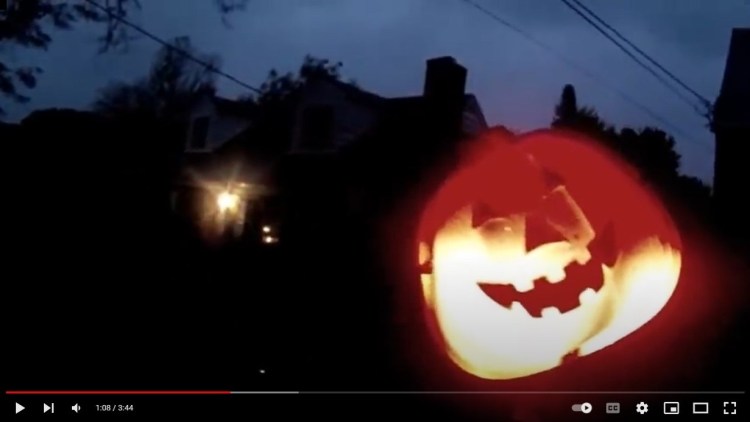
When we next see the boy, he’s with a friend and running away as the two of them engage in some good old-fashioned pretend gunplay. At 1:07, a disembodied and illuminated Jack-O-Lantern, followed by an abrupt change to daylight and a tracking shot into and through a field of corn. The locale has switched, some kind of a county fair with people milling about between fake teepees and oversized plastic farm animals–“I was 14 at the fair declaring things I’d never been” (odd way to phrase that, but I think I get the gist)–but then a quick return to the two boys and the darkness and the illuminated Jack-O-Lanterns, many more of them now. Just before the three-minute mark, a procession of people passes under an archway lit up by hundreds of firefly-like miniature bulbs.
Everyone was dressed up and drinking in the street
Let me stop there: that’s the line that gets to me, the line that shakes loose my own long-gone memories from almost 50 years ago, fragments I can only try to piece together now. I’m thinking specifically of block parties that happened on my small street, Roydon Place (11 houses), the first two or three summers after we moved from Toronto to Georgetown, a small town about 30 miles northwest of the city. This would have been 1968 and ‘69, maybe even into the next decade. The most tangible memory I have is courtesy of a photograph, one that’s either buried in a box somewhere or simply gone, lost in that slides-to-VHS transfer I mentioned earlier in the Karen Dalton/Boards of Canada post: Mr. Holmes (Archie, Scotsman, short, lived in the house two to our right) and Mr. Tomajko (burly, two doors left of the Holmes house; can’t remember his name, but I remember the two teenage sons, Rob and Stephen, and a daughter a little younger than me, Tracey), dressed in garish summer wear, beers in hand, big grins to let in the sun. It was summer, not Halloween, but there were a lot of young kids on our street, at least 15, and the adults had arranged for games and diversions of some sort. There was food, of course, and, going by that photo, lots of alcohol. (My own parents didn’t drink, but I’m sure my dad would have gotten into the spirit of things at least a little.) Anything more concrete than that eludes me–there’s just that one photo. But the “Halloween” video stirs up something that I still carry around with me, feelings I’ve only experienced on rare occasions in the decades since,***** and only in weaker iterations at that.
It’s like it’s always right now, time rushes by too fast, I didn’t know it then–as elusive as what these two videos are trying to tap into might be, I think it’s found somewhere in those words and in these images.
*And if they do, the title (Proxy Music) and cover (a parody of Roxy Music’s debut) of Linda’s album should take care of that.
**In trying to throw together a quick list of couples, I learned that a few who I had assumed were in fact weren’t: Mickey & Sylvia, Dick & Dee Dee, Paul & Paula, Charlie & Inez Foxx (brother and sister, like the Carpenters).
***Trying to find them is not always easy. There’s one for “Blue Line Swinger;” uploaded by metalhedwigh, that I especially love, and another good one for “I Feel Like Going Home.” I swear I once saw one for “Detouring America with Horns,” but it’s either gone or never existed.
****Except for the laptop. It’s 2013; you can’t expect Henry David Thoreau.
*****Like the couple of times I attended Luminato, the all-night street festival that takes over the downtown core of Toronto (and other cities) for a few nights during the summer.
 we don't want to know