I don’t have a hook for this post, no way to link these three videos to the news of the day, some connection either serendipitous or entirely of my own invention.* I’ve been doing that with almost every post since I started, but, if I haven’t made this clear already, I’ll eventually be taking everything here and turning it into a book, and the finish line is within view–there’s this post plus three more. Early on, I was able to look at my master list of videos and, one way or another, mix-and-match my way to those connections, not worrying about how to order everything. There’s no more wiggle room to do that now. These three videos don’t even relate to each other, let alone the news of the day–basically, this is what amounts to a miscellaneous or none-of-the-above grouping.
I discovered Psychic TV’s “Only Love Can Break Your Heart” when I started indiscriminately downloading Neil Young covers roundabout 2005 (Beatles and Velvet Underground covers too). Full tribute albums, stray album tracks, anything and everything I came across. My folder eventually ballooned to approximately 25 full tribute albums,** plus an additional 300 songs, and I wrote about what I’d compiled for a 2007 Stylus piece. Much to my surprise, in an exceptional group of “Only Love” covers (including Saint Etienne’s hit single, the Corrs, and Juliana Hatfield), I thought Psychic TV had the best:
And that leaves the bug-eyed, transgendered Satanist with the lengthiest and best version of all, the strangest thing about which is how very unstrange it is. There’s a lifetime of disappointment and missed opportunities in the counsel kept by “Only Love Can Break Your Heart,” and while the lifetime that Psychic TV’s Genesis P-Orridge brings to the song is undoubtedly a lot more unusual than where Neil was coming from, all that matters in the end is the way he invests every last bit of it into the delicate fall of “Yes, only love can break your heart” each time he hits the chorus. Perfection.
P-Orridge died in 2020 at the age of 70, right on the eve of the pandemic (his death was unrelated). A few months earlier, the “Only Love Can Break Your Heart” video was uploaded to YouTube.
Allowing for one cryptic flourish (“I have a friend I’ve never seen”)–the Neil Young of 1970 had a gift for such gnomic lyrical fragments–“Only Love Can Break Your Heart” imparts a very straightforward bit of advice: because the consequences of getting it wrong are so calamitous, try to be sure right from the start. As a sound, as a mood, the word “plaintive” comes to mind. “Only Love Can Break Your Heart” and “Tell Me Why” (lead track from Young’s After the Gold Rush; “Only Love” sits third, the two of them separated by the more cosmically ethereal title song) are twin towers of early-‘70s singer-songwriter plaintiveness, wise and searching and modest, the small, measured voice of a friend you’ve never seen. All of which Psychic TV’s cover honours beautifully. The accompanying video, though–uploaded by Virgil Pink, who oversees a parallel YouTube channel under the name Mandy Pink;*** I can’t tell if there’s any official affiliation to the band (the Virgil/Mandy bifurcation suggests there may be)–is all about the fragmentary and the cryptic, a puzzle that defies interpretation. There’s nothing the least bit straightforward about it. A sense of confoundment can wear you down over the course of a film,**** but when it comes to the much shorter temporal commitments of a music video, confoundment is almost always a good thing, especially when shot in somber black-and-white.
Psychic TV’s “Only Love Can Break Your Heart” unfolds in a room–there’s nothing so mundane as an establishing shot, but I can tell we’re inside a room because there’s a white wall, like in an Antonioni film. The room is mostly empty, but there’s a table, and on the table, there’s some stuff: toys, a lamp, a pair of scissors…We see these items in quick cuts, but then other times we see the table unadorned, and it’s not actually a table, it’s a minimalist box-like object. There’s also a woman wandering around the room–we see her feet, hands, midsection, and shadow before we get to see her in full 45 seconds in–who sometimes is the one placing those items on the box, while at other times she can be seen draping herself across the top of the box when it’s bare. My first thought, trying to process all this: “Be careful–only love can break your heart.” Shadows are prominent throughout, highlighted by a strikingly mysterious shot at 2:34: the woman, centre-frame and standing on the left side of the box, lifts her head to encounter an unnaturally positioned shadow on the opposite side, legs curling to the right and disappearing out of frame. Whose shadow? There’s been no one else except her thus far. More and more stuff: an ornamental jellyfish, gloves, knick-knacks, a power drill. The elongated shadow appears again at 2:56, this time on the left of the frame, and at 3:06 we get–for the first time, I think–a clear view of the woman’s face reflected in a small pocket mirror, just barely visible in the top center of a blurry, layered image; a hand closes the mirror and she’s gone.
The second half of the six-minute clip drifts towards something resembling a mid-‘60s underground film: dense superimpositions, abstracted backdrops, a horizontally split screen at 4:25, images darkened and images overexposed. Psychic TV’s cover becomes dreamier and dreamier–they’re adding a couple of extra minutes to the original, lost inside the gentle swoon of Neil’s chorus–and so does the video; you can easily imagine it being screened as a backdrop to one of the Exploding Plastic Inevitable shows in 1966. While Neil Young’s own history with music-video has been erratic at best–he made a great one for 1983’s “Wonderin’,” with odd framing and fractured editing rhythms that almost made it feel like stop-motion; in all honesty, I don’t know that he’s ever made anything else that caught my eye–the “Only Love” clip makes me think, “Yes, that’s what the Neil of After the Gold Rush and Everybody Knows This Is Nowhere might have done. That’s what purple words on a gray background and lying in a burned-out basement might look like.”
A couple of Neil’s more heavy-handed videos, as I recall–however well-meaning–had to do with presidents and wars, either impending or underway: “Let’s Roll” (2002), his response to 9/11, and “Let’s Impeach the President” (2006), an indictment of George W. Bush. (The video for 2020’s “Lookin’ for a Leader,” his anti-Trump song, was just a performance clip of Neil playing–probably for the best.)***** Much like Brian de Palma’s Casualties of War, my favourite war film, the only war-related video I hold in high regard–and I’d be lying if I said I can think of more than a handful******–comes from an unlikely source. Blur was at the forefront of mid-‘90s Britpop, a response to American grunge that valued flash and surface and irony much more than the guitar-heavy earnestness characteristic of grunge. Or at least that seems to be the general view today. I don’t remember personally making any connection between, say, Oasis and Nirvana at the time; it was more like a continuum, with this thing coming first and this other thing coming next, and the British stuff seemed a little artier, as it usually does. In any event, based on the few Blur songs I know–the sardonic drone of “There’s No Other Way,”******* their jaunty putdown of suburbia “Parklife” (very British, with a video starring Quadrophenia’s Phil Daniels), the accidental sports-arena anthem “Song 2” (“And I feel heavy metal–woo-hoo!”)–a deadly serious, heartfelt video set on a military aircraft carrier is pretty much the last thing I would have expected from them. I didn’t catch up with “Out of Time” (via the video) till years after the fact; threw me for a bit of a loop at first.
All the footage for the “Out of Time” video was taken from the BBC documentary Warship, the backdrop for which I would assume (it aired in 2002) is the U.S.-Afghanistan War, then just in its second year.******** War films can very clearly document a specific war–The Best Years of Our Lives, Three Kings–they can be more universal, or they can use one war as a stand-in for a conflict more immediate and sensitive; M*A*S*H and Catch-22, both released in 1970, were set in the Korean War, but critics and audiences understood them as really being about the Vietnam War, a subject still too traumatic for a studio-financed American movie to wade into. The “Out of Time” video strikes me as an example of the more universal kind of war film. This could be any aircraft carrier in any war: it’s about boredom, fear, loneliness, and separation.
First image: a woman in close-up, her eyes focussed left, on what we don’t know yet. A couple of shots later we pull back to see people milling about with food trays, and also that the woman is looking at an elevated TV at the back of the frame; if I’m right about the war, the blurred figure on screen looks to be George W. Bush in the middle of a press briefing. We’re on a warship of some sort, it’s mealtime, and in the top left of the frame, a digital time-stamp races forward–this is real footage we’re looking at, and, in keeping with the title, the meter is running.********* Daily ritual takes hold: a female soldier (I don’t think it’s the same woman from the opening shot) brushes her teeth in front of a mirror, her expression distant, preoccupied. As she walks away, we hear Damon Albarn’s voice for the first time (the song’s muted instrumental lead-in has been playing thus far): “Where’s the love song to set us free?” A 30-second tracking shot takes the woman through the ship’s inner workings, where at one point she wordlessly steps aside as another soldier passes, both avoiding eye contact. It’s such a sombre shot–tracking shots are often exhilarating–at once claustrophobic but also opening up an unbridgeable disconnect between the two of them. The woman proceeds through a door to another room and slowly begins to put on special combat gear. Other soldiers in the room look up in her direction. She looks so sad.
And you’ve been so busy lately
That you haven’t found the time
To open up your mind
And watch the world spinning
Gently out of time
We get a close-up of her on the line “Feel the sunshine on your face,” and then she’s proceeding down another corridor, one that takes her above-board and onto the carrier’s deck. At 2:20, a medium shot of her staring out at the water–open, peaceful, limitless–the mood shifts, and then, after a quick track closer, followed by a painterly tableau of the carrier’s breadth from stern to bow (a little Spanish-like instrumental flourish from the song overtop), the narrative takes a turn, with what looks to be a diary entry rendered as four subtitles: “Two days after I get home he leaves. It’s just too hard. I used to love him. But you can’t love someone you don’t know anymore…” The video’s final minute is given over to the beautiful repose of these above-board images, the last one of the woman walking towards flecks of light in the distance, played off against the resignation of the song: “Tell me I’m not dreaming, but are we out of time?” Yes, Albarn answers his own question; yes we are. I wonder what happened to her. Again, she and the footage are (or were) real.
I shy away when writing about art that has to do with war. The subject is so far outside of my own experience, whether as a participant or as a civilian (or even as someone who’s had family members affected–you have to go back quite a ways in my own family for such connections). Getting drunk in bars, though, to shift gears entirely, that’s something I’ve done. It was, in fact, pretty much the primary focus of my social life through my 20s, right up to the point where I got into teachers’ college at the age of 30 (when it became clear the first time I set foot in a classroom that it wasn’t a profession that accommodated hangovers very well). I don’t miss the experience at all, but I do remember it with a certain amount of fondness; hard to say whether it was the experience itself or just the being-young part I miss.
What’s a good getting-drunk song? Must be hundreds of them. A couple that come to mind from my Radio On days are Chumbawumba’s “Tubthumping,” which gets at something, and Semisonic’s “Closing Time,” which gets at something else. (As does Chance the Rapper’s “All Night,” a spirited you-should-never-get-drunk-fella song.) But really, any great song is automatically a good getting-drunk song. I remember some friends and I sitting in what I think was a motel bar situated on Toronto’s Lakeshore one night in the mid-‘80s, where we played the Rolling Stones’ “Sway” and Big Brother’s “Piece of My Heart” over and over again on the jukebox, and for that one night they were the two greatest songs ever.********** Existence precedes essence is how I think that goes; the experience makes the song.
But as for a getting-drunk song that actually speaks to the experience itself, I nominate Tony! Toni! Toné’s “Let’s Get Down,” my second-favourite single of 1996 (checking old ballots, right behind “Peaches” at #1). What a sensuous, dreamy evocation of that feeling of sitting there, looking around, and having everything and everybody feel so…wonderful.
Now that I feel a little better than I felt a while ago, yeah
I’m going back to the same spot
Where I met you on the floor
I can’t remember if I ever actually heard it in a bar or a club that year, but heard in any context, “Let’s Get Down” would instantaneously transport me to the psychic space conveyed by those and other lines (“Now, table one, that’s my folks…”). I couldn’t recall the video, but, when compiling a list of what to write about on this blog, I was hoping it was good enough to warrant inclusion. No. It’s visually interesting (as claustrophobic as the “Out of Time” video), and it captures some of what I hear in the song, but it’s also dated in a manner that I’ve learned–am learning–to avoid.
Somewhere in the same neighbourhood, though, a video from my last few years of scrambling around every December to draw up a Pazz & Jop ballot, a process that involved sampling dozens of videos on YouTube, about 30 seconds from each one, and then either short-listing the song for a full listen later or forgetting about it forever and moving onto the next one. Emerging out of the morass in 2014, Vic Mensa’s “Down on My Luck,” my #1 for the year. Indelible song, with a complex, time-shifting video to match.
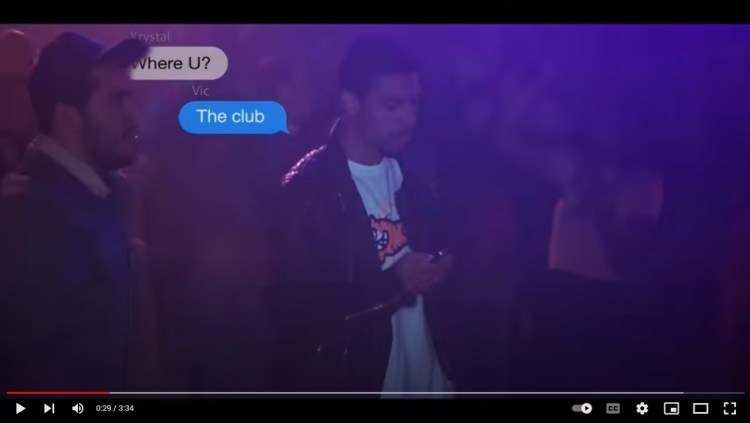
The club–I don’t know the exact timeline, but at some point in the 2000s, the idea of the club acquired near-mythical (and mystical) status in an inexhaustible string of R&B and hip-hop hits. 50 Cent’s “In da Club” (2003) may have kicked this off, or, more likely, he was tapping into something already well underway. By the time of Vic Mensa a decade later, the club was a fact of life–life itself, it sometimes seemed, with nothing existing beyond those walls. And that is indeed where the “Down on My Luck” video begins (after some boldly cinematic text identifying the song and artist), with Mensa on the dance floor in medium close-up (he’s lip-synching the song), his gaze fixed upon a woman situated at the bar. He approaches her as lights flash and people dance, taking a second to glance at his cell phone. “Where U?” pops up on the screen, a text bubble from Krystal, presumably not the woman at the bar. “The club” Mensa texts back (of course), the letters appearing one at a time, and then, the first instance of a narrative that continually loops back on itself, we back up a few seconds and get the same thing all over again, a second and then a third time. Someone grabs Mensa and snaps a selfie (twice), and 50 seconds in, he’s there at the bar with the non-texting woman he’s been eyeing from across the room. He leans into her, cut to a close-up of his drink, and–not sure if this is exactly what he’s after or if it’s done without his knowing–she drops a tablet in there (slightly slowed down as it falls through space). Okay–this could be fun.
Midnight scenes from an old romantic movie
Usually you’d be there, today I say was different
I can take you with me wandering if you wanna go there
The two of them make their way onto the dance floor, Mensa clearly starting to get woozy: he grabs onto her for support, his eyes cloud over, the image blurs, he falls to the floor. The woman reaches over his body and begins to remove his wallet from a back pocket, immediately returning us to Mensa a minute ago, upright and texting and approaching the woman. We’re now 100% in Groundhog Day/Russian Doll/Yogi Berra territory, with Mensa madly drinking and drugging and déjà vu-ing himself into oblivion.
Fourth time through, Vic momentarily gets it together. No pill (“Fuck that–get down”), a brief interlude where he ducks out of frame and cedes the dance floor (and video) to a trio of dancers for 15 seconds, then he steps outside the club into the night. An angry woman shows up–this just has to be the Krystal who was texting him–and throws a drink in his face. A flurry of fast-forwarded trickery follows and, seconds later, we’re back in the club for yet another go-around. This time, his fifth chance to get it right, he joins the trio of dancers, then, when he steps outside, he gets taken away in handcuffs when he tries to spray-paint the club’s exterior wall (taunting the cops with a perfectly synched “Look at you, look at you” from the song). Sixth time, he flips the bird to two guys on the street, immediately thereafter getting plowed down by an oncoming truck; seventh time, as he leaves the club, he lights a cigarette and walks away peacefully.
In the short “Down on My Luck” comment I wrote for my year-end ballot in 2014, I said that its video captured “the vertiginous rabbit-hole of getting drunk as well as Harvey Keitel and “Rubber Biscuit” in Mean Streets, or the 10-minute accordion hootenanny in Satantango.” Which is to say, as well as you can. And if it somehow connects to the Psychic TV and Blur videos (remember, this was supposed to be my orphan entry, with three videos connected neither to the day’s events nor to each other), it’s in the way that all great art does. It creates a world, and for the next four minutes–a club, a warship, an almost-empty room–there is no other.
*Being right in the middle of an incredibly tumultuous month in presidential politics–the fallout from Biden’s disastrous debate, the assassination attempt on Trump, Biden stepping aside for Harris–the temptation is there, especially with titles like “Out of Time” and “Down on My Luck.”
**Psychic TV’s cover comes from The Bridge, a 1989 album in support of Neil Young’s Bridge School–I’m not entirely sure, but I think that may have amounted to the very first tribute album made up of Young covers.
***You could spend the next year exploring Mandy Pink’s YouTube page of over 1,000 homemade videos, including clips for the Velvet Underground, Guided by Voices, Brian Eno, Magnetic Fields, Beat Happening, etc.–a veritable video repository for those thousand people who bought the first VU album.
****I saw Kinds of Kindness the other night, my second Yorgos Lanthimos film. Its confoundment quotient was exceeded within the first half-hour; for the next two-and-a-half, confoundment burrowed deeper and deeper, eventually eating itself, and me, and everything else in the theatre.
*****Again making me think back to much earlier presidents-and-war songs from Neil and the videos that might have been: “Ohio,” “Soldier,” “Ambulance Blues,” “Campaigner.”
******Metallica’s “One,” which liberally mixed in scenes from the 1971 anti-war film Johnny Got His Gun, is probably the most well known; I remember the video being as dreary as the song.
*******Damon Albarn’s blankly sinister glare in the video may have been influenced by Kurt Cobain in the “Smells Like Teen Spirit” video.
********You’d think this would be the easiest thing in the world to pin down, but I’m not having any luck.
*********Another instance of risking a title already belonging to a classic song: the Rolling Stones’ “Out of Time,” used so well over Coming Home’s opening credits. (In the space of two years, the Stones went from having time on their side to being out of it–I’ll leave that for someone else to pursue.)
**********“Sway” may in fact be one of the two greatest songs ever, so maybe not the best example.

