A difficult subject for me to write about: friendship. At the age of 62, it’s not supposed to be that way. You’re supposed to be happily retired, just entering your years as a doting grandparent, focussed on family and travel, and living out your days (to quote R.E.M., which is quite possibly the sorriest thing an aging rock critic can do) filled with joy and wonder. The rewards of friendship should even be enriched in your later years because, with all those other things that are now supposed to be occupying your life, time spent with friends will be less frequent and consequently more precious. It’s certainly not anything to brood over–not anymore.
If you’re on your own, though–not married, no kids–and you’re only able to spend so much time alone (which you very much enjoy up to a point, and that has a lot to do with why you are where you are), friendship is still at the forefront of your thoughts. You see certain friends semi-regularly, others once or twice a year, and you understand the difference. Other friends you haven’t seen for ages; you can reach out, or you might just hold off and wonder why that is. The most difficult thing is accepting that, with married friends, which is basically 90% of the friends you have, you have to be very mindful that getting together may involve a certain amount of what, in the second Godfather film, Frank Pentangeli calls “waiting in the lobby.” You do, but the awareness of that never goes away. (If I ever embark on a career writing fiction, my first novel will be called Afterthought.) You’re not mad, and you really appreciate any and all efforts meant to at least not make it feel that way. Short of that, you have to draw some kind of line–for your mental health, sense of self, or something, you can’t be in a sustainable friendship where you’re forever being taken for granted.* That’s when you stop reaching out; that’s when you’re left in limbo, waiting and wondering. And you’re aware that this is all in your head–chances are that the other person is not even thinking about any of this. You know that. It’s very much a tree-falling-in-the-forest situation.
I have friends who go back to grade school and high school in the ‘70s, others who came along in the ‘80s when I started writing, work-related friends from the next 20 years, and new friends I’ve met since moving five years ago. It’s pretty much impossible to have the same kind of friendship with those newer friends that you have with friends who go back decades. That’s the Albert Brooks Rule, named after something his character says to Holly Hunter’s character in Broadcast News: “I’ll meet you at the place by the thing where we went that time.” Post-retirement, the work-related group can be the most puzzling. Some of those friendships endure; others, you do start to wonder if they were real or just friendships of convenience. A lot like the military, probably, or being a professional athlete.**
I look forward to the day when I never give any of this a second thought.
Favourite songs about friendship…Without googling the subject, the first one that comes to mind is the Kinks’ “See My Friends.” Shimmering, nascent psychedelia, it moves me in the same way as the scene in Ingmar Bergman’s Fanny and Alexander where the family arrives and the one character wistfully says, “Here comes my family.” (Sounds rather mundane on paper; it’s not.) In the Kinks song, Ray Davies’ girlfriend has left him and, looking over at a river (literally or metaphorically, I’m not sure), he sees his friends and decides that they’re all that he has left.*** There’s the Beatles’ “With a Little Help from My Friends,” of course, one of Sgt Pepper’s two greatest songs. Also, a Tame Impala song I love, “It Is Not Meant to Be” (first song on their debut album), the lyrics of which are mostly indecipherable to me, but it contains one line that always catches my ear: “She doesn’t make friends for friendship’s sake.” Good for her–I’d like to think I don’t either. My favourite anti-friendship song is a toss-up between Dylan’s withering “Positively 4th Street” (“you’ve got a lot of nerve…”) and the Undisputed Truth’s “Smiling Faces Sometimes” (“pretend to be your friend”). Somewhere on the continuum, Led Zeppelin’s “Good Times Bad Times”: “When I whispered in her ear, I lost another friend.” If I’m granted one last wish on my deathbed, I want to know what Robert Plant whispered in that woman’s ear.
The two videos I’m writing about here are not explicitly about friendship. One of them, in fact–or at least the song–likely has nothing whatsoever to do with the subject, but that’s how its video hit me 30 years ago (when I wrote about it in my year-end ballot for 1992), and looking at it today, nothing’s changed. Friendship is such a large, complicated idea that obliquely is probably the best approach anyway. If you try to write a straightforward account of what it means to be a good friend, you might end with “That’s What Friends Are For.”
When it comes to the Smiths’ Morrissey, I’m as much outside my comfort zone as I was with Fiona Apple. To a certain subset of listeners, he’s as towering a figure in the history of pop music as Chuck Berry or Bob Dylan. (Or at least he was; he’s had a few issues the past decade that have knocked him off that pedestal.) Myself, I took a brief interest in the Smiths’ first album–I was, comparatively, so much more open-minded back then–and then, down the road some, I surprised even myself by including “Panic”**** on a Facebook list of my 100 favourite songs (with a link, I believe, to a video I would have considered writing about here, but my memories of it just don’t match what I can find on YouTube today–very likely I’m remembering a user-created clip that has long since disappeared). When Morrissey gets excoriated today for a whole bunch of things he’s said in interviews and online, I realize he falls into that category of public figures where I get to completely avoid making up my mind about the seriousness of his words because I just don’t care enough about the speaker to give a second’s thought to the matter.
And then there’s “Tomorrow,” the closing track on Morrissey’s third solo album, Your Arsenal (safely on the deification side of his personal timeline). What I wrote at the time on that ballot, which had a spot for videos:
One long tracking shot of Morrissey and his friends walking through city streets, Morrissey in front and his friends following. Halfway through, Morrissey starts looking over his shoulder. He’ll take a sidelong glance, walk some more, take another look; he slows down a bit, they slow down a bit, he looks again, he keeps walking. Are they still there? Every time he looks, it’s like he’s sure they won’t be.
First thought: how exactly did one check the details of a music video pre-YouTube? Did I sit around monitoring MuchMusic for hours on end, waiting for them to play it again? It’s possible I recorded it onto a VHS tape in anticipation of writing about the song or video again–“Tomorrow” was likely relegated to one of their specialty “indie” shows and not in regular rotation; the only radio station that would have played it in Toronto was one I found unbearably self-righteous–but recording music videos is not anything I remember doing. Who knows, maybe I wrote about it from memory. It was a strange world back then.
If so, that would explain at least one error: while it’s close to one long tracking shot, there are a number of cuts in the video’s first 15 seconds as Morrissey stands alone in an alleyway and does some photogenic bits of business. Also, are these actually supposed to be his friends (or maybe, Morrissey being British, I should have said “mates”) following him? Maybe it’s just his band. When they catch up to Morrissey at the 3:20 mark, I find it so ambiguous the way they greet each other, part of why the video has stayed in my mind all these years: it’s like they haven’t just spent the past three minutes walking along in lockstep, and it’s hard to know whether they’re renewing old acquaintances, if they’d arranged to meet up with each other that day, or if they’re making introductions for the first time ever. Even more intriguing, right at the minute-and-a-half mark as Morrissey walks along idly, drumming his fingers against an adjacent wall, lost in his thoughts, he wears an expression of…boredom? calculation? a flash of awareness so unpleasant it has to be immediately discarded? The cumulative effect–the jangly drone of the song, the elegant precision of the tracking shot, Morrissey’s flair for the enigmatic gesture–is mesmerizing, and the decision to film in black and white only adds to that.
Oddly, on the same LP as “Tomorrow” is the better known (because of its brazenly disarming title) “We Hate It When Our Friends Become Successful.” Do we? Well, when we’re younger, we do worry that wildly successful friends may leave us behind. By the time he recorded “We Hate It,” though, it was Morrissey who was famous, so you’d think that anxiety would no longer apply to him. As evidenced by the “Tomorrow” video, though, he’s still looking over his shoulder.
The unofficial video for Deerhunter’s “He Would Have Laughed” (uploaded onto YouTube by Lazarus Taxon on September 28, 2010, exactly one day after Halcyon Digest was released–makes me wonder if it actually is band-approved) is at once more specifically about friendship than “Tomorrow”’s and also more abstract. The song is a tribute to Jay Reatard, a friend and sometimes collaborator who died earlier that year; it’s about a friend, but also, possibly, it channels the voice of Reatard himself. No surprise, I came to Deerhunter late. When I put “Fluorescent Grey”***** on my 2008 year-end, they’d already released two albums and an EP. I called it “older-brother music” in my accompanying comment, a term Scott Woods and I came up with for music that you were exposed to in the early ‘70s–the metal and art-rock that didn’t make it onto Top 40 radio–that felt like “a secret glimpse into a mysterious world that seems so much more adult than the one you’re used to” (an older brother may or may not have been involved in the transaction). “Fluorescent Grey” was basically a two-note keyboard riff sustained for five minutes, with the words “patiently, patiently” weaving in and out. “He Would Have Laughed” comes across like older-brother music too, but it’s a much more fragmentary song, an obscure reverie that drifts off into lyrics about land sales,****** farms, and boredom. Older-brother music needs an older-brother video, and Taxon’s “He Would Have Laughed” clip conveys the song’s fragmentation with three videos rolled into one: 30 seconds of experimental Brakhage stuff to start (Rorschach-like blots with a negative-space bird appearing and reappearing), followed by four minutes of found home movies and random old footage of indeterminate origin, and finishing with another three of some band that I’m pretty sure isn’t Deerhunter jamming in the backyard, all flying V-necks and synchronized hair-tossing like they’re Uriah Heep in 1972.
The home movies set up a sobering contrast with the song’s opening line: “Only bored as I get older.” We get the view from inside a car of a small-town street with a “Season’s Greetings” banner; some grainy, slow-motion images of a family at play on the beach; a blonde-haired young woman spinning herself around gracefully. (The family and the woman remind me of the home-movie flashbacks of Harry Dean Stanton and Nastassja Kinski in Paris, Texas.)******* “Can you help me figure this out?” Bradford Cox sings–these should be images of great comfort, but maybe, in the end, they’re not enough. (Deerhunter’s “Find new ways just to spend my time” = R.E.M.’s “Another prop to occupy my time.”) More family footage (in color this time) of a mother joyfully swinging her child through the air, three shadowy figures climbing some stairs, and then an abrupt shift to a floor filled with people dressed to the nines and dancing to a jazz orchestra from the 1940s. Can you help me figure this out?
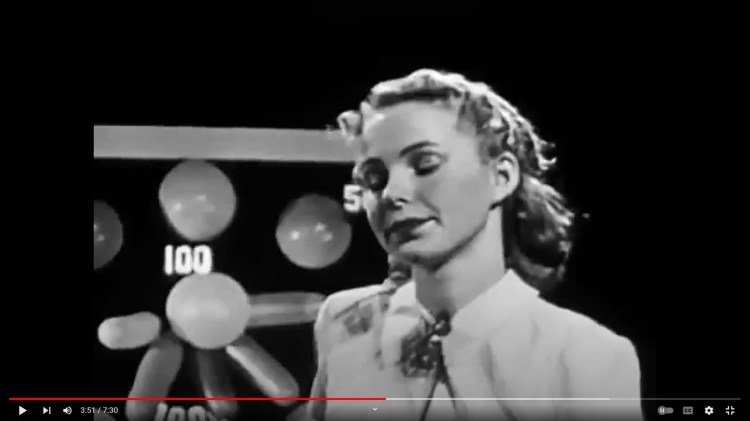
Probably it doesn’t need figuring out–it’s pushing all my buttons (the home movies, the dreaminess, the willful obscurity),******** so I’m looking for meaning that will elevate it to something more than a quirky subjective pick. The dancers are broken up by four people sitting in a car (still the ‘40s or thereabouts) and the first appearance of some text: “There a reason”–cut back to the dancers–“I care.” Not sure if those two phrases are meant to be distinct (there’s a reason, and the reason is that I care) or joined together into a single thought (there’s a reason I care–think about everything you’re seeing, and you’ll know what it is). The same words turn up two more times as we move into a procession of paired faces; sometimes they’re mirrored on each side of the frame like Rorschach blots in human form, other times they’re mixed and matched. Cut to a woman standing in front of what looks to be some kind of display board from a 1950s game show–it’s quite baffling; I don’t know what it is–and as the camera slowly zooms in on her, she tilts her head and closes her eyes. At 4:07, a strip of celluloid goes up in flames and the image goes black. This is the bridge–for the video, and for the song too, which remakes itself (it’s been as trancelike as “Fluorescent Grey” thus far, a stuttering six-note loop) after a few seconds of what sounds like the circus-y glockenspiel intro to the Beach Boys’ “Wouldn’t It Be Nice.” The bridge takes us into that backyard, trance gives way to melody, slow gets slower, and we drift. Barely audible: “Come on, dream on.”
I said earlier that the band jamming in the video’s last section was clearly not Deerhunter, but–and this would jibe with my suspicion that the clip wasn’t user-uploaded, but was in fact posted by the band itself under a pseudonym–I wouldn’t be at all surprised if what we’re seeing is footage of Jay Reatard messing around with his friends when he was younger. Maybe his first band, maybe a fake video that he and a few friends made on a lark. I don’t know–again, something you would think you could check easily but can’t. What we’re hearing may be Bradford Cox addressing Reatard, or it may be Cox speaking for Reatard, which is what I think–not “friend” singular but “friends” plural. If you’re dead, you may indeed wonder where all your friends went.
I lived on a table
I don’t know where to go
I know my friends would
I know where my friends are now
I lived on a farm, yeah
I never lived on a farm
Where did my friends go?
Where did my friends go?*********
The band relocates to some train tracks, and, at 6:43 (“Ah, shut the hell/Shut your mouth”), black-and-white turns to colour–over-exposed, but with lots of verdant green foliage visible behind them and rather beautiful. Somebody runs down the track with his guitar in his hand, the band plays some more, and the song stops abruptly, like someone getting cut off mid-sentence.
“Where did my friends go?”: such a sad, troubling question.********** I wish I could chime in with some wisdom of my own here, but as you may have noticed earlier, I don’t have any. Maybe I’ll figure out every last nuance of friendship in the next month or two–most of all, when not to read meaning into something where none exists–in which case I’ll pass on what I’ve discovered in an epilogue written specially for the book version. A brief footnote will probably be enough.
*Have I ever been guilty of this myself? I’m sure I have. Eventually, all you’re doing is keeping score.
**Facebook added at least two or three new categories to the friendship taxonomy, the most specious of which requires quotation marks: not friendships of convenience, and not friends for friendship’s sake either, but “friends” who evidently have some connection to someone you know, and there’s no compelling reason you can see to turn them away.
***Checking Wikipedia for some details, the song was evidently about much more than that.
****Controversy there, too, though milder than what came later. Completely detached from any considerations of race, “Panic”’s chorus of “Hang the DJ” is a great line. But you can’t detach it–directed at dance music, much of it performed by Black artists and, I’m guessing (I don’t know anything about the UK club scene circa anytime), played by Black DJ’s, the line has a terrible connotation. Definitely a case of “maybe consider choosing other words.” But I totally understand “The music that they constantly play/It says nothing to me about my life.” Anybody who’s a listener understands that line, even if we all apply it differently. For me, the line would cover about 98% of everything the Smiths ever did.
*****Actually released in 2007; in 2008 “Fluorescent Grey” was covered by, yes, Jay Reatard, the A-side of a single where Reatard and Deerhunter each covered a song by the other.
******I speculated on the message board once that “He Would Have Laughed” may have had something to do with 2007’s There Will Be Blood, that on the line “I’m a gold, gold digging man/I won’t rest ’til I buy your land” we were hearing the voice of Daniel Plainview. A bit of a stretch, yes.
*******A couple of weeks after writing that, I attended a rep screening of Paris, Texas and, what do you know, the shot of the “Season’s Greetings” banner is actually lifted from Wim Wenders’ film. Hunter Carson, who plays the young boy in Paris, Texas, has a line that eloquently addresses one of the mysteries of home movies as he looks at footage of the mom he hasn’t seen since before he can remember: “She’s not real.”
********When mp3 blogs were all over the internet, one of my favourites was Wilfully Obscure (mostly ‘80s and ‘90s power-pop).
*********The online lyrics site I consulted puts each of those lines in quotation marks. Maybe they’re working from a lyrics sheet that came with the album, but I’m not sure, so I left them out. The accuracy of lyrics sites is notoriously hit or miss.
**********Which reminds me of another favourite song on the subject, Bette Midler’s cover of Buzzy Linhart’s “Friends” (1972), with its strong evocation of Vietnam: “I got some friends but they’re gone/Someone came and took them away.”
 we don't want to know